


Page 205 - (DK Eyewitness) Travel Guide: Japan
P. 205
WESTERN HONSHU 203
7 Kii Peninsula
Kii Peninsula
Wakayama, Mie, and Nara prefectures.
k Nanki-Shirahama. £ JR Kinokuni
line. _ Nachi Fire Matsuri (Jul 14).
The Kii Peninsula, with dense ly
forested mountains at its center
and craggy headlands, pine-
covered islands, and coves
along its shoreline, has largely
avoided the industrial Kano-school screens inside Kongobu-ji, Mount Koya
development that scars much
of Japan’s Pacific coastline. peninsula’s southernmost point built in 1593 by Toyotomi
A good starting point is the is marked by Shio-no-misaki, Hideyoshi (see p60), is Koya-san’s
small port town of Shingu, on a headland with a white light- chief temple. Its rhododendrons
the east coast. From here you house dating from 1863. One and the sliding doors of its inner
can take a bus to Shiko, then a of the three oldest hot springs chambers, painted in the 16th
50-minute boat trip takes you in Japan, Shirahama Onsen, century by artists of the Kano
along the Kumano River to Doro on the west coast, also has one school, are among its special
Valley, one of Japan’s most of the area’s finest beaches. attractions. The magnificent
spectacular gorges. From May to Danjogaran complex, is one
June rhododendrons and azaleas P Taiji Whale Museum of the two most sacred sites
bloom on the river’s banks. Tel (0735) 59-2400. Open daily. & on the mountain, the Fudo-
A 20-minute bus ride inland do (Fudo Hall), built in 1189,
from Shingu lies Nachi-no-taki, and the Konpon Dai-to, an
Japan’s highest waterfall. A 8 Mount Koya impressive two-story vermilion-
and-white pagoda. Rebuilt in
stone path ascending paral lel to Mount Koya Monastery
the falls leads to Nachi Taisha 1937, the pagoda is regarded
shrine, its origins reach ing back Wakayama prefecture. * 3,400. as the symbol of Koya-san.
£ Nankai line from Osaka, then cable
over 1,400 years. The next port The aptly named Reihokan
south of Shingu is Katsuura, car from Gokurakubashi stn. n nr (Treasure House) stands
Senjuinbashi bus stop (0736) 56-2616.
a pleasant pine-studded bay Open daily. & some buildings. op posite the complex, a cornu-
with several pic turesque islets. _ Aoba Matsuri (Jun 15), Rosoku copia of over 5,000 paintings,
Visitors interested in the Matsuri (Candlelight Festival, Aug 13). statues, and mandalas dis played
Japanese perspective on ∑ eng.shukubo.net in two separate buildings. The
whaling should go to nearby gigantic Daimon (great
Taiji, a whaling community Set amid clumps of black gate), the traditional main
since the 17th century. For cedar at an altitude of 900 entrance to Koya-san, lies
insight into a complex subject, m (3,000 ft) in the heart of a little west of here on the
visit the Taiji Whale Museum. the Kii Penin sula, Mount edge of the plateau. It
Farther south, the resort of Koya, or Koya-san, is affords a matchless
Kushimoto is known for a chain Japan’s most venerated view of mountains,
of 30 rocks, Hashi-gui-iwa, that Shin gon-Buddhist site. valleys and, on clear
seem to march out to sea, It is host to over one days, distant Shikoku
connecting the town to the million pilgrims a year. and Awaji islands.
island of Oshima. The Saint Kukai (774–835), In the eastern half of
also known by his A burial stone at Koya-san is a necropolis
post humous name, Okuno-in, Mount Koya of over 200,000 tombs,
Kobo Daishi, estab- and the Okuno-in
lished a monastic retreat here (inner sanctum), Kukai’s
in 816. There were almost 1,000 mausoleum. Great status is
temples on the mountain by attached to burial on Koya-san.
the Edo period, but typhoons The stone-paved approach to
and fire have since reduced the Okuno-in is flanked with statues,
number to 117. The mountain’s monu ments, and tombs housing
unique atmosphere is best the remains of Japan’s most
experienced with an overnight power ful and illustrious families.
stay. Traditional vegetarian In front of Kukai’s mausoleum is
cuisine is served in Koya-san’s the Toro-do (Lantern Hall). Day
53 temple lodgings. and night 11,000 lanterns burn
The western part of Koya-san here, including two that are said
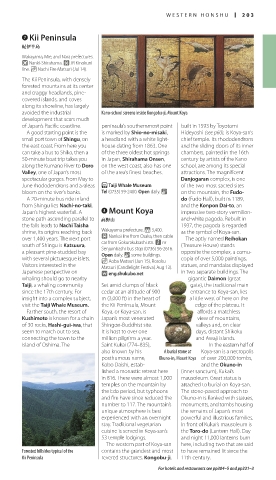
Forested hillsides typical of the contains the grandest and most to have remained lit since the
Kii Peninsula revered structures. Kongobu-ji, 11th century.
For hotels and restaurants see pp304–5 and pp331–3
202-203_EW_Japan.indd 203 08/08/16 3:07 pm

