


Page 210 - (DK Eyewitness) Travel Guide: Japan
P. 210
208 JAP AN REGION B Y REGION
0 Kobe E Chinatown
Kobe 5-min walk S of Motomachi stn.
The city’s 14,000 or more
Kobe enjoyed a brisk trade with China and Korea from the 8th Chinese residents have turned
century on and was one of the first ports to benefit when this quarter (Nankin-machi)
Japan reopened to Western trade in 1868. Today, there is a into a lively and colorful slice
large expatriate community, notably Chinese and Koreans, of Kobe life. Approached
through four large gateways,
but also Europeans, Americans, and Indians. The city became the central plaza, Nankin Park, is
famous over night in 1995 when a huge earthquake struck. surrounded by Chinese restau-
However, there is little evidence of the disaster now, so rants and trinket shops, and it is
effectively has this cosmopolitan city been rebuilt. The filled with street vendors. The
downtown area is famous for its nightlife. Kobe beef, park has statues representing
meanwhile, is one of the world’s most well-known meats. the 12 animals of the Chinese
astro logical calendar.
P Kobe City Museum
10-min walk S of Motomachi stn.
Open 9am–5pm Tue–Sun, but
check website for temporary closures.
& ∑ city.kobe.lg.jp/culture/
culture/institution/museum
This museum covers the history
of the city from the earliest times
until its reconstruction after the
1995 earthquake. There is an
intriguing display of objects
retrieved from the Old Foreign
Settlement and a scale model of
the area. The muse um also has
the world’s pre mier collection
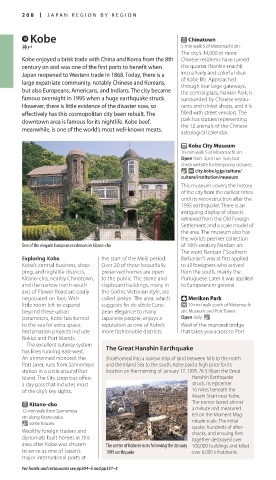
One of the elegant European residences in Kitano-cho of 16th-century Nanban art.
The word Nanban (“Southern
Exploring Kobe the start of the Meiji period. Barbarian”) was at first applied
Kobe’s central business, shop- Over 20 of these beautifully to all for eigners who arrived
ping, and nightlife districts, preserved homes are open from the south, mainly the
Kitano-cho, nearby Chinatown, to the public. The stone and Portuguese. Later it was applied
and the narrow north-south clapboard buildings, many in to Europeans in general.
axis of Flower Road are easily the Gothic Victorian style, are
negotiated on foot. With called ijinkan. The area, which Y Meriken Park
little room left to expand suggests fin de siècle Euro- £ 10-min walk south of Motomachi
beyond these urban pean elegance to many stn. Museum and Port Tower:
parameters, Kobe has turned Japanese people, enjoys a Open daily. &
to the sea for extra space. reputation as one of Kobe’s West of the monorail bridge
Reclamation projects in clude more fashionable districts. that takes you across to Port
Rokko and Port Islands.
The excellent subway system The Great Hanshin Earthquake
has lines running east-west.
An unmanned monorail, the Shoehorned into a narrow strip of land between hills to the north
Port Liner, runs from Sannomiya and the Inland Sea to the south, Kobe paid a high price for its
station in a circle around Port location on the morning of January 17, 1995. At 5:46am the Great
Island. The City Loop bus offers Hanshin Earthquake
a day pass that includes most struck, its epicenter
of the city’s key sights. 10 miles beneath the
Akashi Strait near Kobe.
E Kitano-cho The tremor lasted almost
12-min walk from Sannomiya a minute and measured
stn along Kitano-zaka. 6.9 on the Moment Mag-
& some houses. nitude scale. The initial
Wealthy foreign traders and quake, hundreds of after-
shocks, and ensuing fires
diplomats built homes in this together destroyed over
area after Kobe was chosen The center of Kobe in ruins following the January 100,000 buildings and killed
to serve as one of Japan’s 1995 earthquake over 6,000 inhabitants.
major international ports at
For hotels and restaurants see pp304–5 and pp331–3
208-209_EW_Japan.indd 208 08/08/16 3:07 pm
Eyewitness Travel LAYERS PRINTED:
Catalogue template “UK” LAYER
(Source v2.6)
Date 12th July 2013
Size 125mm x 217mm

