


Page 225 - (DK Eyewitness) Travel Guide: Japan
P. 225
WESTERN HONSHU 223
founding fathers has a large number of well-
came from Hagi. preserved samurai houses.
Today it is best Thousands of carp inhabit the
known for its over town’s brooks, outnumbering
400- year-old the residents, it is said, by ten to
pottery-making one. Tsuwano’s Catholic Church
tradition. Hagi’s (1931) commemorates 36
charm is in the Japanese Christians who
details: its tea- were martyred here in 1868.
houses, mossy On the other side of town, the
cemeteries, and hillside Taikodani Inari Shrine
the tiny, purple is one of the most important
bloom of bush Cemetery of Toko-ji temple near Hagi Inari (fox) shrines in Japan. It is
clover (hagi), the E Kikuya House reached through a tunnel of
town’s namesake. vermilion torii (gates), 1,174 in all.
The central Teramachi Open daily. & A chairlift goes up the other side
district contains old temples P Ishii Tea Bowl Museum of the slope to the scant remains
and shrines, each with its own Open Thu–Tue. & of Tsuwano Castle with a
special features. Jonen-ji is P Kumaya Art Museum stunning view from the top.
noted for its finely carved gate, Open Tue–Sun. & Nishi Amane (1829–97), a
Hofuku-ji its bibbed Jizo Meiji-period statesman and
statues, Kyotoku-ji for its Environs philosopher, was born here.
immaculate garden, and East of the river is the house of Nishi House, now a museum, is
Choju-ji for an atmos- Yoshida Shoin, an influential late- on a quiet street in the south of
pheric ceme tery. Edo educator, philosopher, and town. Opposite is Mori Ougai
Camellias and revolutionary. Shoin shrine and House, a museum to the army
natsu mikan memorial are dedicated to him. surgeon, writer, and translator
(summer The nearby temple of Toko-ji, Mori Ogai (1862–1922), known
oranges) with its impressive three-story for novels such as The Wild
hanging over gate, was founded in 1691 by the Geese and Vita Sexualis, and
long, white- third Mori lord. The Mori tombs also a Tsuwano native.
washed mud are at the end of a path flanked
Yoshida Shoin walls typify by almost 500 stone lanterns. E Nishi House
monument, the samurai The natural salt-water Myojin Open daily.
outside Hagi quarters to Lagoon is 5 km (3 miles) from E Mori Ougai House
the west of town. A volcano, Mount Tel (0856) 72-3210. Open Tue–Sun. &
Teramachi. Sever al residences Kasayama, stands beside
are located here, including the the far end of the lake.
homes of the Kido and Taka-
sugi families, and Kikuya
House, a merchant villa with a j Tsuwano
small museum and beautiful Tsuwano
garden attached. The Ishii Tea
Bowl Museum has a superb Shimane prefecture. * 7,600. £ @
n next to Tsuwano stn (0856)
ceramics collection.
Wealthy merchants appoint ed 72-1771. _ Sagimai (Heron Dance
Festival, Jul 20, 27).
by the Mori clan once owned
the fine collection in the This tiny 700-year old former
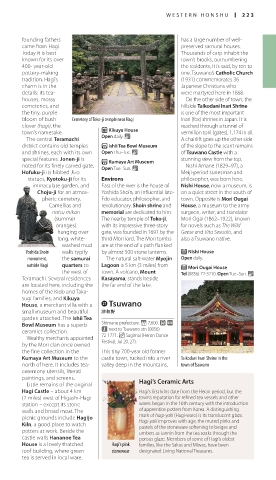
Kumaya Art Museum to the castle town, tucked into a river Taikodani Inari Shrine in the
north of here. It includes tea- valley deep in the moun tains, town of Tsuwano
ceremony utensils, literati
paintings, and screens. Hagi’s Ceramic Arts
Little remains of the original
Hagi Castle – about 4 km Hagi’s first kilns date from the Heian period, but the
(2 miles) west of Higashi-Hagi town’s reputation for refined tea vessels and other
station – except its stone wares began in the 16th century with the introduction
walls and broad moat. The of apprentice potters from Korea. A distinguishing
picnic grounds include Hagijo mark of hagi-yaki (Hagi-ware) is its translucent glaze.
Hagi-yaki improves with age, the muted pinks and
Kiln, a good place to watch pastels of the stoneware softening to beiges and
potters at work. Beside the umbers as tannin from the tea soaks through the
castle walls Hananoe Tea porous glaze. Members of some of Hagi’s oldest
House is a lovely thatched- Hagi’s pink families, like the Sakas and Miwas, have been
roof building, where green stonewear designated Living National Treasures.
tea is served in local ware.
222-223_EW_Japan.indd 223 08/08/16 3:08 pm

