


Page 227 - (DK Eyewitness) Travel Guide: Japan
P. 227
JAP AN REGION B Y REGION 225
SHIKOKU
For centuries, the Seto Inland Sea formed a natural barrier isolating Japan’s
fourth largest island from much of the forces of popu lation growth and
Westernization. Still relatively off the tourist track, despite the construction
of bridges across the water, Shikoku offers a nostalgic glimpse of fishing and
farming villages, and of rice paddies set against a backdrop of forested hills,
castles, and temples.
Late Paleolithic sites and kofun (tumuli) where many of their descendants still
dating from the 3rd cen tury AD are live. Farmland and mountains con tinue
evidence of early human activity on to dominate Shikoku’s landscape,
Shikoku. The Dogo Onsen (spa) in although agriculture employs only
Matsuyama is referred to in the Kojiki, three percent of the island’s four
Japan’s oldest chronicle, written in 712. million resi dents. Assembly of autos
Despite such ancient sites, how ever, and manufacture of electronic goods,
Shikoku has mainly been on the margin of particularly in the ports along the
Japanese his tory. The island’s most famous Seto Inland Sea, are the most important
figure is Kukai, who was born into a poor industries. Other industries include fruit
aristrocratic Shikoku family in 774. This farming (mandarin oranges in particular),
Buddhist priest, who has been called the seaweed and pearl cultivation, and food
Father of Japanese Culture, visited 88 of and chemical proc essing.
the island’s temples in a pilgrimage that Shikoku’s coastline remains relatively
has been imitated by others for more unspoiled, despite construction altering
than a thousand years. most of Japan’s coastal areas. The capes
In 1183, as chronicled in the Tale of the that jut into the Pacific, Muroto to the east
Heike, the war between the Taira and and Ashizuri to the west, offer panoramic
Minamoto clans for dominance of Japan vistas rarely seen in Japan.
spilled over into the Inland Sea and Shikoku is connected to Honshu
Shikoku. Some of the defeated Taira went by the Seto-Ohashi Bridge and two
into hiding in a gorge in central Shikoku, other bridges.
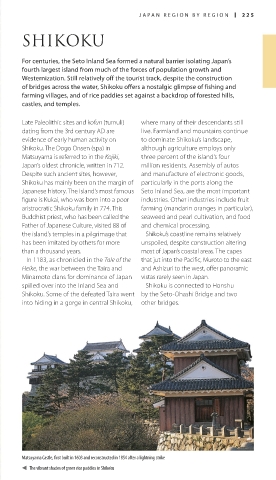
Matsuyama Castle, first built in 1603 and reconstructed in 1854 after a lightning strike
The vibrant shades of green rice paddies in Shikoku
224-225_EW_Japan.indd 225 08/08/16 3:08 pm

