


Page 271 - (DK Eyewitness) Travel Guide: Japan
P. 271
NIKK O 269
VISITORS’ CHECKLIST
Practical Information
Tochigi prefecture. * 84,000.
n at Tobu Nikko stn (0288)
54-2496. _ Tosho-gu Grand
Festival May 17–18); Tosho-gu Fall
Festival (Oct 17).
∑ nikko-travel.jp/english/
Transport
£ JR and Tobu-Nikko lines.
Taiyuin-byo Shrine
See pp274–5.
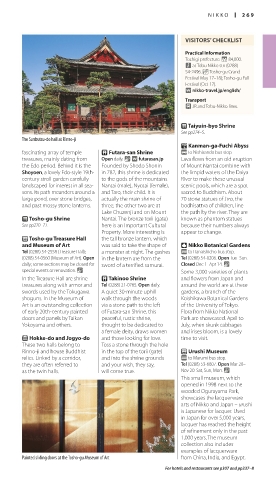
The Sanbutsu-do hall at Rinno-ji
} Kanman-ga-Fuchi Abyss
fascin ating array of temple Futara-san Shrine @ to Nishisando bus stop.
treasures, mainly dating from Open daily. & ∑ futarasan.jp Lava flows from an old eruption
the Edo period. Behind it is the Founded by Shodo Shonin of Mount Nantai combine with
Shoyoen, a lovely Edo-style 19th- in 782, this shrine is dedicated the limpid waters of the Daiya
century stroll garden carefully to the gods of the mountains River to make these unusual
landscaped for interest in all sea- Nantai (male), Nyotai (female), scenic pools, which are a spot
sons. Its path meanders around a and Taro, their child. It is sacred to Buddhism. About
large pond, over stone bridges, actually the main shrine of 70 stone statues of Jizo, the
and past mossy stone lanterns. three; the other two are at bodhisattva of children, line
Lake Chuzen ji and on Mount the path by the river. They are
Tosho-gu Shrine Nantai. The bronze torii (gate) known as phantom statues
See pp270–71. here is an Important Cultural because their numbers always
Property. More interesting is appear to change.
P Tosho-gu Treasure Hall the tall bronze lan tern, which
and Museum of Art was said to take the shape of Y Nikko Botanical Gardens
Tel (0288) 54-2558 (Treasure Hall); a monster at night. The gashes @ to Hanaishicho bus stop.
(0288) 54-0560 (Museum of Art). Open in the lantern are from the Tel (0288) 54-0206. Open Tue–Sun.
daily; some sections may be closed for sword of a terrified samurai. Closed Dec 1–Apr 14. &
special events or renovation. & Some 3,000 varieties of plants
In the Treasure Hall are shrine Takinoo Shrine and flowers from Japan and
treasures along with armor and Tel (0288) 21-0765. Open daily. around the world are at these
swords used by the Tokugawa A quiet 30-minute uphill gardens, a branch of the
shoguns. In the Museum of walk through the woods Koishikawa Botanical Gardens
Art is an outstanding collec tion via a stone path to the left of the University of Tokyo.
of early 20th-century painted of Futara-san Shrine, this Flora from Nikko National
doors and panels by Taikan peaceful, rustic shrine, Park are showcased. April to
Yokoyama and others. thought to be dedi cated to July, when skunk cabbages
a female deity, draws women and irises bloom, is a lovely
E Hokke-do and Jogyo-do and those looking for love. time to visit.
These two halls belong to Toss a stone through the hole
Rinno-ji and house Buddhist in the top of the torii (gate) P Urushi Museum
relics. Linked by a corridor, and into the shrine grounds @ to Marumi bus stop.
they are often referred to and your wish, they say, Tel (0288) 53-6807. Open Mar 20–
as the twin halls. will come true. Nov 20: Sat, Sun, Mon. &
This small museum, which
opened in 1998 next to the
wooded Ogurayama Park,
showcases the lacquerware
arts of Nikko and Japan – urushi
is Japanese for lacquer. Used
in Japan for over 5,000 years,
lacquer has reached the height
of refine ment only in the past
1,000 years. The museum
collection also includes
examples of lacquerware
Painted sliding doors at the Tosho-gu Museum of Art from China, India, and Egypt.
For hotels and restaurants see p307 and pp337–8
268-269_EW_Japan.indd 269 08/08/16 3:08 pm

