


Page 267 - (DK Eyewitness) Travel Guide: Japan
P. 267
JAP AN REGION B Y REGION 265
NORTHERN HONSHU
When haiku poet Matsuo Basho set out in 1689 on his five-month trek to
northern Japan, he likened it to going to the back of beyond. Three centuries
later, shinkansen lines and expressways provide easy access, and the north is as
much a part of the information age as the rest of Japan. The region nevertheless
retains its quiet, rural image, a place where life is lived at a more congenial pace.
The backcountry reputation of Northern vegetables in spring, oys ters in winter,
Honshu belies its rich history. Long ago, and seafood all year are other reasons
it was home to indigenous people, who to visit the north, while its cool sum mers
may have been Ainu (see p291). In the provide relief from the heat and
12th century, Hiraizumi was the capital humidity farther south. The wealth
of the Northern Fujiwara clan, rival ing of crafts and folk arts, such as Nanbu
Kyoto in splendor. During feudal times, testsubin (iron ket tles) in Morioka,
Morioka, Tsuruoka, Hirosaki, and Aizu- wooden kokeshi dolls, Aizu and Tsugaru
Wakamatsu were thriving castle towns. lacquerware, kabazaiku (cherry-bark
Foremost, though, was Sendai, ruled by craft), and Mashiko pottery, are
the north’s most powerful clan and now renowned in Japan and internationally.
the region’s largest city. These and other On March 11, 2011, a 9-magnitude
north-country won ders, such as the earth quake and subse quent tsunami
shrines and temples of Nikko and Dewa hit this northern part of Japan. Much
Sanzan, are now tourist attractions. of the area was damaged with some
Known for its excellent rice and fine coastal areas completely destroyed.
sake, northern Japan is the country’s The Fukushima Daiichi nuclear plant was
main rice-producer. Agri culture is now also badly damaged by the tsunami,
mechanized, but farmers still work hard resulting in the evacuation of people
for a liv ing. Mushrooms in autumn, wild living near the plant.
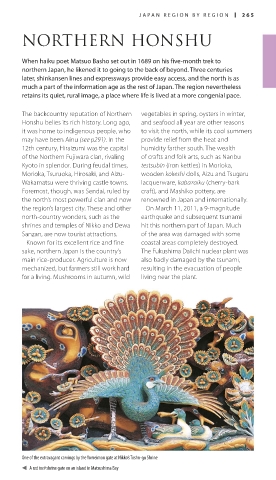
One of the extravagant carvings by the Yomeimon gate at Nikko’s Tosho-gu Shrine
A red torii shrine gate on an island in Matsushima Bay
264-265_EW_Japan.indd 265 08/08/16 3:08 pm

