


Page 296 - (DK Eyewitness) Travel Guide: Japan
P. 296
294 JAP AN REGION B Y REGION
9 Kushiro Wetlands flowing rivers. By day, they
National Park forage along streams and
marsh edges, or fly to one of
Kushiro Wetlands
three major feeding sites north
k Kushiro. £ Kushiro stn. @ from of Kushiro: two in Tsurui vil lage
Kushiro. n JR Kushiro stn (0154) and one in Akan village.
22-8294. These sites offer the best
opportunities for viewing
If any creature represents the cranes year round. Whooper swans congregating at
Japan, it is the beautiful tancho, On late winter days, the Akkeshi Bay
or red-crowned crane, birds display, calling and
regarded as a symbol of dancing to one another cranes breed upriver and at
happi ness and long life in the snow as they the nearby Kiritappu wetland.
(myth has it that it lives prepare for the breeding The coastal road from Akkeshi
a thousand years). To season ahead. around to Kiritappu is well worth
the Ainu, the crane is In summer (May to driving – both for the scenery
a god of the marshes – September), the cranes are and for an insight into the
sarurun kamui. The territorial, occupying large, fishing and seaweed-harvesting
Kushiro Wetlands National traditional nesting grounds lifestyles of some of the people
Park is typical of its where they usually raise in this region. Walking at the
natural environment. just one chick, or cape beyond Kiritappu is
This enormous peat A red-crowned crane occasionally two. In the exhilarating, but early summer
swamp, an expanse of lush green summer mornings are best avoided
undulating reed beds reed beds, even these tall birds because this is when a sea mist is
bisected by streams, north are well hidden, but may be most likely to conceal the view.
of the coastal port city of spotted at the marsh fringes.
Kushiro is one of the main
homes of these enormous, q Lake Furen
graceful birds that stand 1.4 m 0 Akkeshi Bay Lake Furen
(4 ft 6 in) high. The cranes are Akkeshi Bay
also found in other wetlands of k Kushiro. £ Nemuro stn.
southeast Hokkaido, albeit k Kushiro. £ Akkeshi stn. n 1st
in smaller numbers. Floor, Akkeshi Gourmet Park, 2-2 A far cry from Japan’s crowded
In the early 20th century, the Suminoe, Akkeshi-cho, Akkeshi-gun cityscapes, the huge 52 sq-km
(0153) 52-4139.
cranes were pushed to the (20 sq-mile) lagoon of Lake Furen
verge of extinction in Japan by is surrounded by expan sive,
a combination of hunting and Akkeshi’s sheltered tidal lagoon eye-relaxing landscape. Situated
loss of habitat, but now protec- is renowned for the quality of its on Hokkaido’s east coast, this
tion and provision of food for oysters. The bay is extensively lake is the seasonal haunt of
them during the winter months farmed, and there is a shrine hordes of birds: migrating
has helped the young cranes to the oysters on a rocky islet. waterfowl in spring and fall,
survive, boosting the popu- Throughout the winter, and swans in late fall, sea eagles
lation to around 700 birds. especially during spring and fall in winter, and breeding red-
During the winter nights migration, hundreds of whooper crowned cranes during summer.
(December to March) the swans gather in the inner bay, Nearly 20 km (12 miles) long
cranes roost in the safety of while in summer red-crowned and up to 4 km (2 miles) wide,
the lagoon is only 2 m
(6 ft) deep or less in
places. It is fringed by
forests of fir and spruce,
with alder and birch
scrub in wetter areas.
Some easy forest walks
start from the south
end of the lake, at
Hakkuchodai and
Shunkunitai, offering a
wealth of birdwatching
opportunities and
plenty of wildflowers
en route. In winter, the
frozen lagoon and
adjacent areas are good
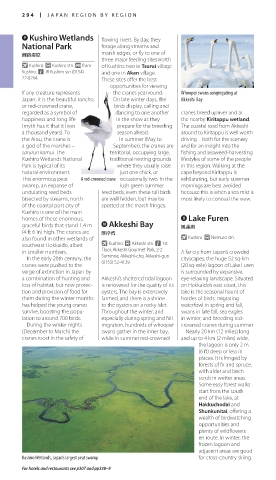
Kushiro Wetlands, Japan’s largest peat swamp for cross-country skiing.
For hotels and restaurants see p307 and pp338–9
294-295_EW_Japan.indd 294 08/08/16 3:09 pm
Eyewitness Travel LAYERS PRINTED:
Catalogue template “UK” LAYER
(Source v2.6)
Date 12th July 2013
Size 125mm x 217mm

