


Page 297 - (DK Eyewitness) Travel Guide: Japan
P. 297
HOKK AIDO 295
w Nemuro they are overshadowed by the
Peninsula world’s largest eagle: Steller’s
Nemuro Peninsula sea eagle. Both types of eagles
are best seen in winter north of
k Nemuro-Nakashibetsu. Rausu on the southeast coast.
£ Nemuro stn. n in front of North of Utoro lie the pretty
Nemuro stn (0153) 24-3104. Shiretoko Five Lakes, reflecting
Mount Rausu. There is an easy
In contrast to the rugged, 2-km (1-mile) trail starting
mountainous Shiretoko Penin- beyond the Visitor Center, and
sula of northeast Hokkaido, the onsen-enthusiasts will not want
Nemuro Peninsula in the south- A red fox, often seen on the to miss the hot waterfall known
east is low-lying, essentially a Nemuro Peninsula as Kamui wakka, northeast of
coastal plateau carved by streams here. From May to October the
into steep-sided gullies, and well Rausu. The peninsula supports high pass from Utoro to Rausu
loved by naturalists. The best one of the healthiest remain ing (Route 334) is open, and the view
way to explore the area is by car. populations of brown bears east from here to Kunashiri island
The red fox is common here left in Hokkaido. Sightings are is dramatic. This road passes
and, in forests around the base few and far between, although through the subalpine zone,
of the peninsula, particularly in the boat ride from Utoro (on which is dominated by dwarf
the Onetto area, there are also the northwest coast) north to stone pine trees. From near
many sika deer. In summer, lilies, the cape during the summer the pass, a hiking trail strikes
fritil laries, and other wildflowers is one possible way of seeing off south for Lake
are abundant, while in winter, them as they forage along Rausu and Mount
although the cape appears the coastal strip. Onnebetsu, while
bleak and inhospitable, both Minke whales, dolphins, another heads north
white-tailed and Steller’s sea and porpoises may be for Mounts Rausu,
eagles can be seen. Offshore seen in summer, too, Io, and Shiretoko
and in the many sheltered along with seabirds and the cape beyond.
harbors and bays, there are such as spectacled For most levels of
flocks of sea ducks, particularly guillemots, Japanese Steller’s sea eagle fitness, Mount Rausu
scoters and harlequins, and cormorants, and is a manageable day
many other seabirds can be migratory short- hike along a good trail. The
spotted in the coastal waters. tailed shearwaters. journey to the cape, however,
At the base of the penin sula, Several pairs of white-tailed requires several days and
the quiet town of Nemuro has sea eagles nest along the pen- careful planning. The long, cold
little to offer the visitor, apart insula. In winter their numbers winters and short summers
from being a practical base. are swollen by hundreds more here make hiking possible
At Cape Nosappu the viewing arriving from Russia, but then only from June to September.
tower overlooks the Russian-
occupied islands across the
narrow Nemuro Channel.
e Shiretoko
National Park
Shimetoko Peninsula
k Memanbetsu (Abashiri) or
Nakashibetsu. £ Shiretoko-Shari stn.
n Shiretoko Shizen center (01522)
4-2114.
This rugged finger of land,
jutting 65 km (40 miles)
northeast into the Okhotsk Sea,
was named Shiretoko (“the end
of the earth”) by the Ainu. Now
a World Heritage Site, Shiretoko
National Park is the wildest such
park in Japan. Its 386 sq km
(150 sq miles) consist of a well-
forested mountainous ridge of
volcanic peaks dominated by
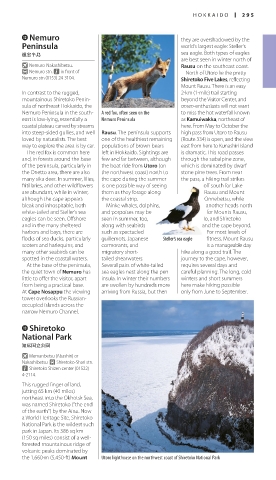
the 1,660-m (5,450-ft) Mount Utoro lighthouse on the northwest coast of Shiretoko National Park
294-295_EW_Japan.indd 295 08/08/16 3:09 pm

