


Page 352 - (DK Eyewitness) Travel Guide: Japan
P. 352
350 TR A VELERS ’ NEEDS
SPORTS AND OUTDOOR
ACTIVITIES
Japan enjoys many traditional sports in some of the martial arts, takes more
activities as well as imports from abroad. planning. As competitive and spectator
Some sports that are closely identified sports, sumo and baseball rank upper -
with Japan – judo, for instance, which is most along with soccer. Golf and fishing
a matter of extreme national pride at are immensely popular pastimes. With its
international competi tion level – have long coastline, mountainous interior, and
been adopted worldwide. Others, like range in climate, Japan is also ideal for
sumo wrestling, are more exclusively outdoor pursuits, from water sports to
Japanese. It is relatively easy to see most mountain climbing, a perfect complement
sports in action; participation, especially to the pleasures of urban Japan.
Other Martial Arts
These fall into two
cate gories, traditional (budo),
and the others. They can be
further classified as those
involving weapons, and those
that are empty-handed (see
p39). While it is relatively easy
to view most sports in action,
to be accepted for training in
one of the tradi tional martial
arts usually requires personal
introductions.
Kendo, under the official
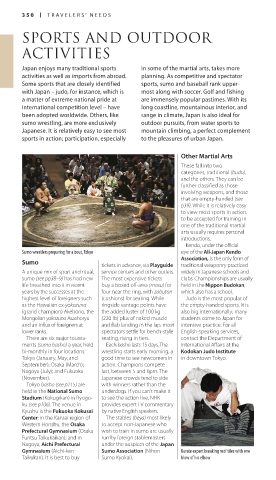
Sumo wrestlers preparing for a bout, Tokyo eye of the All-Japan Kendo
Association, is the only form of
Sumo tickets in ad vance, via Playguide traditional weaponry practiced
A unique mix of sport and ritual, service centers and other outlets. widely in Japanese schools and
sumo (see pp38–9) has had new The most expensive tickets clubs. Champion ships are usually
life breathed into it in recent buy a boxed off-area (masu) for held in the Nippon Budokan,
years by the successes at the four near the ring, with zabuton which also has a school.
highest level of foreign ers such (cushions) for seating. While Judo is the most popular of
as the Hawai ian ex-yokozuna ringside vantage points have the empty-handed sports. It is
(grand cham pion) Akebono, the the added luster of 100 kg also big internationally; many
Mon golian yoko zuna Asashoryu (220 lb) plus of naked muscle students come to Japan for
and an influx of foreigners at and flab landing in the lap, most intensive practice. For all
lower ranks. spectators settle for bench-style English-speaking services,
There are six major tourna- seating, rising in tiers. contact the Department of
ments (sumo basho) a year, held Each basho lasts 15 days. The International Affairs at the
bi-monthly in four locations: wrestling starts early morning, a Kodokan Judo Institute
Tokyo (January, May, and good time to see newcomers in in downtown Tokyo.
September); Osaka (March); action. Champions compete
Nagoya (July); and Fukuoka last, between 5 and 6pm. The
(November). Japanese crowds tend to side
Tokyo basho (see p115) are with winners rather than the
held in the National Sumo underdogs. If you can’t make it
Stadium (Kokugikan) in Ryo go - to see the action live, NHK
ku (see p106). The venue in provides expert TV commen tary
Kyushu is the Fukuoka Kokusai by native English speakers.
Center; in the Kansai region of The stables (beya) most likely
Western Honshu, the Osaka to accept non-Japanese who
Prefectural Gymna sium (Osaka wish to train in sumo are usually
Furitsu Taiku kaikan); and in run by foreign stable masters
Nagoya, Aichi Prefectural under the auspices of the Japan
Gymnasium (Aichi-ken Sumo Association (Nihon Karate expert breaking roof tiles with one
Taikukan). It is best to buy Sumo Kyokai). blow of his elbow
350-351_EW_Japan.indd 350 08/08/16 3:09 pm
Eyewitness Travel LAYERS PRINTED:
Practical template “UK” LAYER
(Source v1.7)
Date 5th March 2013
Size 125mm x 217mm

