


Page 356 - (DK Eyewitness) Travel Guide: Japan
P. 356
354 TR A VELERS ’ NEEDS
SPECIAL INTERESTS
Besides the more obvious tourist sights, exchange of ideas between Japanese and
Japan has many attractions for visitors who overseas visitors. Goodwill Guides are locals,
wish to learn more about diverse aspects of often housewives and retired people, who
Japan ese culture. Traditional medicine and want to practice and maintain their foreign
Zen Buddhism, for example, are of great language skills, and who are willing to show
interest to many Western tourists, and foreigners around the local sights free of
various organizations exist in Japan to charge. Invariably, such individuals are
promote foreigners’ under standing of these enthusiastic about their own and other
subjects. Other visitors are more interested people’s cultures. Using conversation
in modern Japan and will want to take the lounges is an excellent way to establish
opportunity to visit factories or design intercultural friendships, while the
showcases. Various systems have been Homestay and Home Visit systems offer
developed to facilitate more contact and unique insights into Japanese culture.
Conversation Lounges
The basic premise of
conversation lounges is to
bring together Japanese who
want to practice their English
and other foreign languages,
and visitors from abroad who
want to meet Japanese people
in relaxed surroundings.
Sometimes also described
as coffee lounges, these
conversation venues can vary
in both intent and tone.
Mickey House in Takada
nobaba is free for native
English speak ers; others
can pay each visit. They also
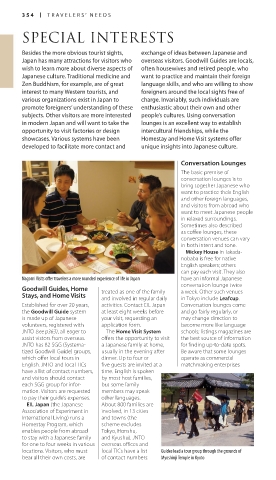
Nagomi Visits offer travelers a more rounded experience of life in Japan have an informal Japanese
conversation lounge twice
Goodwill Guides, Home treated as one of the family a week. Other such venues
Stays, and Home Visits
and involved in regular daily in Tokyo include Leafcup.
Established for over 20 years, activities. Contact EIL Japan Conversation lounges come
the Goodwill Guide system at least eight weeks before and go fairly regularly, or
is made up of Japanese your visit, requesting an may change direction to
volunteers, registered with application form. become more like language
JNTO (see p363), all eager to The Home Visit System schools; listings magazines are
assist vistors from overseas. offers the opportunity to visit the best source of information
JNTO has 82 SGG (Systema a Japanese family at home, for find ing uptodate spots.
tized Goodwill Guide) groups, usually in the evening after Be aware that some lounges
which offer local tours in dinner. Up to four or operate as commercial
English. JNTO and local TICs five guests are invited at a match making enterprises –
have a list of contact numbers, time. English is spoken
and visitors should contact by most host families,
each SGG group for infor but some family
mation. Visitors are requested members may speak
to pay their guide’s expenses. other languages.
EIL Japan (the Japanese About 800 families are
Association of Experiment in involved, in 13 cities
International Living) runs a and towns (the
Homestay Program, which scheme excludes
enables people from abroad Tokyo, Honshu,
to stay with a Japanese family and Kyushu). JNTO
for one to four weeks in various overseas offices and
locations. Visitors, who must local TICs have a list Guides lead a tour group through the grounds of
bear all their own costs, are of contact numbers. Myoshinji Temple in Kyoto
354-355_EW_Japan.indd 354 08/08/16 3:09 pm
Eyewitness Travel LAYERS PRINTED:
Practical template “UK” LAYER
(Source v1.7)
Date 5th March 2013
Size 125mm x 217mm

