


Page 368 - (DK Eyewitness) Travel Guide: Japan
P. 368
366 SUR VIV AL GUIDE
speak the language well, are
usually accepted to a greater
extent (and expected to
conform to Japanese ways),
but even they can never
fully belong.
Meeting Japanese People
The Japanese have a reputation
for their reserve and polite ness,
but in fact their social behavior
is more complex, dictated by
the situation, the place, the
people involved, as well as
the social expec tations. The
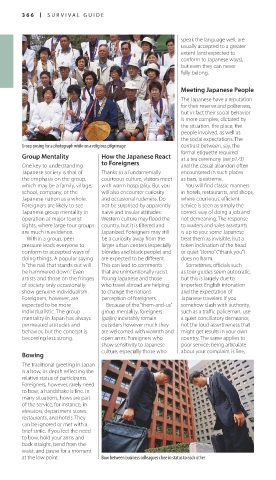
Group posing for a photograph while on a religious pilgrimage contrast between, say, the
formal etiquette required
Group Mentality How the Japanese React at a tea ceremony (see p173)
One key to understanding to Foreigners and the casual abandon often
Japanese society is that of Thanks to a fundamentally encountered in such places
the emphasis on the group, courteous culture, visitors meet as bars, is extreme.
which may be a family, village, with warm hospitality. But you You will find classic manners
school, company, or the will also encounter curiosity in hotels, restaurants, and shops,
Japanese nation as a whole. and occasional rudeness. Do where courteous, efficient
Foreigners are likely to see not be surprised by apparently service is seen as simply the
Japanese group mentality in naive and insular attitudes: correct way of doing a job and
operation at major tourist Western culture may flood the not demean ing. The response
sights, where large tour groups country, but it is filtered and to waiters and sales assistants
are much in evidence. Japanized. Foreigners may still is up to you: some Japanese
Within a group, peer be a curiosity away from the treat them as invisible, but a
pressure leads everyone to larger urban centers (especially token inclination of the head
conform to accepted ways of blondes and black people) and or quiet “domo” (“thank you”)
doing things. A popular saying are expected to be different. does no harm.
is “the nail that stands out will This can lead to comments Sometimes, officials such
be hammered down.” Even that are uninten tionally racist. as tour guides seem autocratic,
artists and those on the fringes Young Japanese and those but this is largely due to
of society only occasionally who travel abroad are helping imperfect English intonation
show genuine individualism. to change the nation’s and the expecta tion of
Foreigners, however, are perception of foreigners. Japanese travelers. If you
expected to be more Because of the “them-and-us” somehow clash with authority,
individualistic. The group group mentality, foreigners such as a traffic policeman, use
mentality in Japan has always (gaijin) inevitably remain a quiet conciliatory demeanor,
permeated attitudes and outsiders however much they not the loud assertiveness that
behavior, but the concept is are welcomed with warmth and might get results in your own
becoming less strong. open arms. Foreigners who country. The same applies to
show sensitivity to Japanese poor service: being articulate
culture, especially those who about your complaint is fine,
Bowing
The traditional greeting in Japan
is a bow, its depth reflecting the
relative status of participants.
Foreigners, however, rarely need
to bow; a handshake is fine. In
many situations, bows are part
of the service, for instance, in
elevators, department stores,
restaurants, and hotels. They
can be ignored or met with a
brief smile. If you feel the need
to bow, hold your arms and
back straight, bend from the
waist, and pause for a moment
at the low point. Bow between business colleagues close in status to each other
366-367_EW_Japan.indd 366 08/08/16 3:10 pm
Eyewitness Travel LAYERS PRINTED:
Practical template “UK” LAYER
(Source v1.7)
Date 5th March 2013
Size 125mm x 217mm

