


Page 369 - (DK Eyewitness) Travel Guide: Japan
P. 369
PR A C TIC AL INFORM A TION 367
but do so quietly and politely.
In conversations generally, avoid
confrontation and causing loss
of face (although this is not as
vital as in some other parts of
Asia). The main purpose of
conversation for many Japan ese
people is not the inter change
of ideas but building a relation-
ship. Therefore, small talk
is considered important.
Away from the big cities, you
may well be asked to pose for
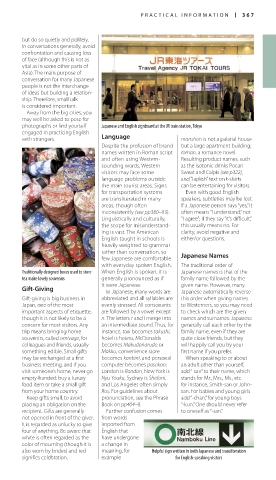
photographs or find yourself Japanese and English signboard at the JR train station, Tokyo
engaged in practicing English
with strangers. Language manshon is not a palatial house
Despite the profusion of brand but a large apartment building;
names written in Roman script roman, a romance novel.
and often using Western- Resulting product names, such
sounding words, Western as the isotonic drinks Pocari
visitors may face some Sweat and Calpis (see p322),
language problems outside and “Japlish” text on t-shirts
the main tourist areas. Signs can be entertaining for visitors.
for transportation systems Even with good English
are transliterated in many speakers, subtleties may be lost.
areas, though often If a Japanese person says “yes,” it
inconsistently (see pp380–83). often means “I under stand,” not
Linguistically and culturally, “I agree”; if they say “it’s difficult,”
the scope for misunderstand- this usually means no. For
ing is vast. The American clarity, avoid negative and
English taught in schools is either/or questions.
heavily weighted to grammar
rather than conversation, so
few Japanese are comfortable Japanese Names
with everyday spoken English. The traditional order of
Traditionally designed boxes used to store When English is spoken, it is Japanese names is that of the
tea make lovely souvenirs generally pronounced as if family name followed by the
it were Japanese. given name. However, many
Gift-Giving In Japanese, many words are Japanese automatically reverse
Gift-giving is big business in abbreviated and all syllables are this order when giving names
Japan, one of the most evenly stressed. All consonants to Westerners, so you may need
important aspects of etiquette, are followed by a vowel except to check which are the given
though it is not likely to be a n. The letters r and l merge into names and surnames. Japanese
concern for most visitors. Any an intermediate sound. Thus, for generally call each other by the
trip means bringing home instance, taxi becomes takushi, family name, even if they are
souvenirs, called omivage, for hotel is hoteru, McDonalds quite close friends, but they
colleagues and friends, usually becomes Makudonarudo or will happily call you by your
something edible. Small gifts Makku, convenience store first name if you prefer.
may be exchanged at a first becomes konbini, and personal When speaking to or about
business meeting, and if you computer becomes pasokon; an adult other than yourself,
visit someone’s home, never go London is Rondon, New York is add “-san” to their name, which
empty-handed: buy a luxury Nyu Youku, Sydney is Shidoni, stands for Mr., Mrs., Ms., etc –
food item or take a small gift and Los Angeles often simply for instance, Smith-san or John-
from your home country. Ros. For guidelines about san. For babies and young girls
Keep gifts small, to avoid pronun ciation, see the Phrase add “-chan,” for young boys
placing an obligation on the Book on pp404–8. “-kun.” One should never refer
recipient. Gifts are gener ally Further confusion comes to oneself as “-san.”
not opened in front of the giver. from words
It is regarded as unlucky to give imported from
four of any thing. Be aware that English that
white is often regarded as the have undergone
color of mourning (though it is a change in
also worn by brides) and red meaning, for Helpful sign written in both Japanese and transliteration
signifies celebration. example for English-speaking visitors
366-367_EW_Japan.indd 367 08/08/16 3:10 pm

