


Page 72 - (DK Eyewitness) Travel Guide: Japan
P. 72
70 T OK Y O AREA B Y AREA
1 Street-by-Street: Ginza
Ginza
When Ieyasu moved his military capital to Edo in 1600, Ginza
was all swamp and marshland. Once filled in, the area attracted
tradesmen and merchants. The silver mint that provided Ginza’s
name, “silver place,” was built in 1612. In 1872 fire destroyed
everything and, with the Meiji Restoration in full swing, the
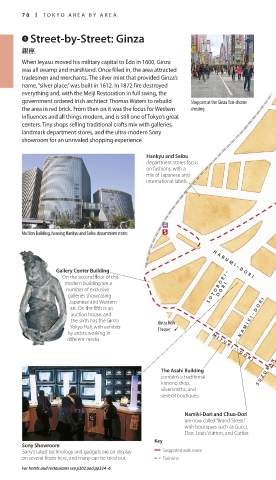
government ordered Irish architect Thomas Waters to rebuild Shoppers at the Ginza Yon-chome
the area in red brick. From then on it was the focus for Western crossing
influences and all things modern, and is still one of Tokyo’s great
centers. Tiny shops selling traditional crafts mix with galleries,
land mark department stores, and the ultra-modern Sony R I –
showroom for an unrivaled shopping experience. O I
B R
O O
Hankyu and Seibu O T D
department stores focus S
on fashions, with a
mix of Japanese and
international labels.
I
R
Mullion Building, housing Hankyu and Seibu department stores O
– D
I
K
I
M
A
N
Gallery Center Building –
On the second floor of this R I
H A R U M I – D O R I
modern building are a B O R I
number of exclusive O
galleries showcasing O T O D I
Japanese and Western S R
art. On the fifth is an D O
auction house, and I –
the sixth has the Ginza Ginza Noh K
Yokyo Hall, with exhibits Theater M I
by artists working in N A
A N – D O R I O R I
different media.
M I Y U K I – D O R I
The Asahi Building O – D
contains a traditional S U Z U R H U
kimono shop, C
silversmiths, and
several boutiques.
Namiki-Dori and Chuo-Dori
are now called “Brand Street”
with boutiques such as Gucci,
Dior, Louis Vuitton, and Cartier.
Key
Sony Showroom
Sony’s latest technology and gadgets are on display Suggested walk route
on several floors here, and many can be tried out. Train line
For hotels and restaurants see p302 and pp324–6
070-071_EW_Japan.indd 70 08/08/16 2:53 pm

