


Page 79 - (DK Eyewitness) Travel Guide: Japan
P. 79
CENTR AL T OK Y O 77
y Kanda Myojin u Akihabara
Shrine Electronics District
Kanda Myojin Shrine Akihabara Electronics District
Map 3 C4. Tel (03) 3254-0753. Map 3 C4. Akihabara stn, Hibiya
Ochanomizu stn, Marunouchi line. £ Akihabara stn, Yamanote,
line. £ Ochanomizu stn, Chuo & Chuo & Sobu lines.
Sobu lines. Open 24 hours daily.
Museum: Open 10am–4pm Sat, Sun Akihabara electronics district
& public hols. & _ Kanda Matsuri surrounds Akihabara station.
(weekend closest to May 15 in Directly under the station is a
alternate, odd-numbered years).
bazaar of tiny shops along
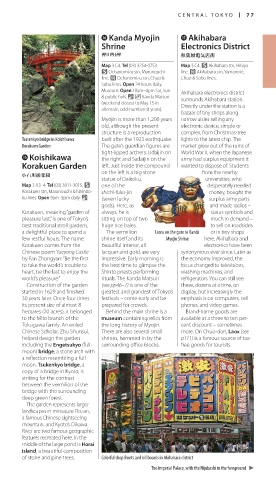
Myojin is more than 1,200 years narrow aisles selling any
old, although the present electronic device, simple or
structure is a repro duction complex, from Christmas-tree
Tsutenkyo bridge in Koishikawa built after the 1923 earthquake. lights to the latest chip. The
Korakuen Garden The gate’s guard ian figures are market grew out of the ruins of
tight-lipped archers: Udaijin on World War II, when the Japanese
t Koishikawa the right and Sadaijin on the army had surplus equipment it
Korakuen Garden left. Just inside the compound wanted to dispose of. Students
on the left is a big stone from the nearby
Koishikawa Korakuen Garden
statue of Daikoku, universities, who
Map 3 A3–4. Tel (03) 3811-3015. one of the desperately needed
Korakuen stn, Marunouchi & Nambo- shichi-fuku-jin money, bought the
ku lines. Open 9am–5pm daily. & (seven lucky surplus army parts
gods). Here, as and made radios –
Korakuen, meaning “garden of always, he is status symbols and
pleasure last,” is one of Tokyo’s sitting on top of two much in demand –
best traditional stroll gardens, huge rice bales. to sell on roadsides
a delightful place to spend a The vermilion Lions on the gate to Kanda or in tiny shops
few restful hours. The name shrine itself and its Myojin Shrine here. Akiha bara and
Korakuen comes from the beautiful interior, all electronics have been
Chinese poem Yueyang Castle lacquer and gold, are very synonymous ever since. Later as
by Fan Zhongyan: “Be the first impressive. Early morning is the economy improved, the
to take the world’s trouble to the best time to glimpse the focus changed to televisions,
heart, be the last to enjoy the Shinto priests performing washing machines, and
world’s pleasure.” rituals. The Kanda Matsuri refrigerators. You can still see
Construction of the garden (see pp46–7) is one of the these, dozens at a time, on
started in 1629 and finished greatest and grandest of Tokyo’s display, but increasingly the
30 years later. Once four times festivals – come early and be emphasis is on computers, cell
its present size of almost 8 prepared for crowds. phones, and video games.
hectares (20 acres), it belonged Behind the main shrine is a Brand-name goods are
to the Mito branch of the museum containing relics from available at a three to ten per-
Tokugawa family. An exiled the long history of Myojin. cent discount – sometimes
Chinese Scholar, Zhu Shunsui, There are also several small more. On Chuo-dori, Laox (see
helped design the garden shrines, hemmed in by the p111) is a famous source of tax-
including the Engetsukyo (full- surrounding office blocks. free goods for tourists.
moon) bridge, a stone arch with
a reflection resembling a full
moon. Tsukenkyo bridge, a
copy of a bridge in Kyoto, is
striking for the contrast
between the vermilion of the
bridge with the surrounding
deep green forest.
The garden represents larger
landscapes in miniature. Rozan,
a famous Chinese sightseeing
mountain, and Kyoto’s Oikawa
River are two famous geo graphic
features recreated here. In the
middle of the large pond is Horai
island, a beautiful composition
of stone and pine trees. Colorful shop fronts and billboards in Akihabara district
The Imperial Palace, with the Nijubashi in the foreground
076-077_EW_Japan.indd 77 08/08/16 2:53 pm

