


Page 86 - (DK Eyewitness) Travel Guide: Japan
P. 86
84 T OK Y O AREA B Y AREA
2 Tokyo National Museum
Honkan
Tokyo National Museum Heiseikan
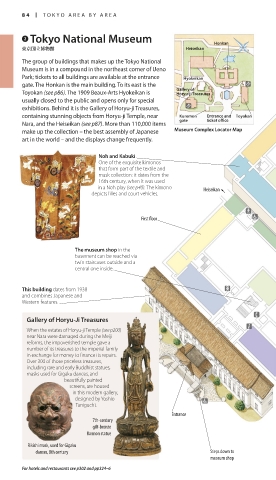
The group of buildings that makes up the Tokyo National
Museum is in a compound in the north east corner of Ueno
Park; tickets to all buildings are available at the entrance Hyokeikan
gate. The Honkan is the main building. To its east is the
Toyokan (see p86). The 1909 Beaux-Arts Hyokeikan is Gallery of
Horyu-ji Treasures
usually closed to the public and opens only for special
exhibitions. Behind it is the Gallery of Horyu-ji Treasures,
containing stunning objects from Horyu-ji Temple, near Kuromon Entrance and Toyokan
gate
ticket office
Nara, and the Heiseikan (see p87). More than 110,000 items
make up the collection – the best assembly of Japanese Museum Complex Locator Map
art in the world – and the displays change frequently.
Noh and Kabuki
One of the exquisite kimonos
that form part of the textile and
mask collection: it dates from the
16th century, when it was used
in a Noh play (see p40). The kimono Heiseikan
depicts lilies and court vehicles.
First floor
The museum shop in the
basement can be reached via
twin staircases outside and a
central one inside.
This building dates from 1938
and combines Japanese and
Western features.
Gallery of Horyu-Ji Treasures
When the estates of Horyu-ji Temple (see p200)
near Nara were damaged during the Meiji
reforms, the impoverished temple gave a
number of its treasures to the imperial family
in exchange for money to finance its repairs.
Over 300 of those priceless treasures,
including rare and early Buddhist statues,
masks used for Gigaku dances, and
beautifully painted
screens, are housed
in this modern gallery,
designed by Yoshio
Taniguchi.
Entrance
7th-century
gilt-bronze
Kannon statue
Rikishi mask, used for Gigaku
dances, 8th century Steps down to
museum shop
For hotels and restaurants see p302 and pp324–6
084-085_EW_Japan.indd 84 08/08/16 3:06 pm

