


Page 108 - (DK Eyewitness) Travel Guide - Scotland
P. 108
106 SC O TLAND REGION B Y REGION GLASGOW 107
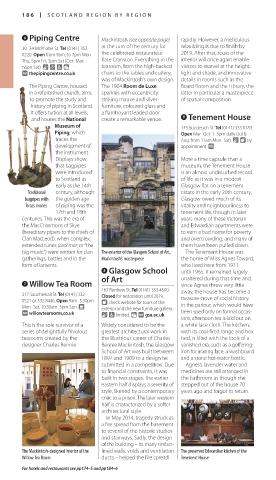
6 Piping Centre Mackintosh (see opposite page) rapidly. However, a meticulous
30–34 McPhater St. Tel (0141) 353 at the turn of the century for rebuilding is due to finish by Glasgow Artists
0220. Open from 9am; to 7pm Mon– the celebrated restaurateur 2019. After that, tours of the
Thu, 5pm Fri, 3pm Sat (Oct–Mar: Kate Cranston. Everything in the interior will once again enable The late 19th century was a time of great artistic activity in Glasgow, with painters such
noon Sat). & 0 7 = tearoom, from the high-backed visitors to marvel at the height, as Sir James Guthrie, Robert McGregor and others rising to prominence. But snobbery
∑ thepipingcentre.co.uk chairs to the tables and cutlery, light and shade, and innovative on the part of the Edinburgh-based arts establishment often led these men to seek
was of Mackintosh’s own design. details in rooms such as the
The Piping Centre, housed The 1904 Room de Luxe Board Room and the Library, the recogni tion outside Scotland. The term “Glasgow School” was coined after an 1890
in a refur bished church, aims sparkles with eccentricity: latter in particular a master piece London exhibition, but the artists generally called themselves “Glasgow Boys”. Art
to promote the study and striking mauve and silver of spatial composition. Nouveau designer Charles Rennie Mackintosh contributed his genius to the creative life
history of piping in Scot land. furniture, coloured glass and of the city as well as to a new Glasgow School of Art, com pleted in two stages – 1899 and
It offers tuition at all levels, a flamboyant leaded door 9 Tenement House 1909. More recently, the term Glasgow Boys has been used to describe the generation of
and houses the National create a remarkable venue. artists who attended the School of Art in the 1970s and ’80s. Contemporary Glasgow
Museum of 145 Buccleuch St. Tel (0141) 333 0183.
Piping, which Open Mar–Oct: 1–5pm daily (Jul & artists include Ken Currie and Peter Howson.
traces the Aug: from 11am Mon–Sat). & 8 by
development of appointment. « Stirling Station, by
the instrument. William Kennedy
Displays show More a time capsule than a (1859–1918), depicts
that bagpipes museum, the Tenement House the crowded platform
were intro duced is an almost undisturbed record with people waiting for
to Scot land as of life as it was in a modest a train. The rich colours,
early as the 14th Glasgow flat on a tenement and steam from the
Traditional century, although estate in the early 20th century. trains, contribute to
bagpipes with the golden age Glasgow owed much of its the atmosphere of
brass drones of piping was the vitality and neigh bourliness to this bustling station.
17th and 18th tenement life, though in later
centuries. This was the era of years many of these Victorian
the MacCrim mons of Skye and Edward ian apartments were A Star (1891) by Sir John Lavery is
(hereditary pipers to the chiefs of to earn a bad name for poverty indicative of the artist’s dashing, fluid,
Clan MacLeod), when com plex, and overcrowding, and many of style as a portraitist. Born in Belfast,
extended tunes (ceol mor, or “the them have been pulled down. Lavery studied at Glasgow and was part
of the Whistler- and Impres sionist-
big music”) were writ ten for clan The exterior of the Glasgow School of Art, The Tenement House was influenced Glasgow School.
gatherings, battles and in the Mackintosh’s masterpiece the home of Miss Agnes Toward,
form of laments. who lived here from 1911
8 Glasgow School until 1965. It remained largely
of Art unaltered during that time and,
7 Willow Tea Room since Agnes threw very little
167 Renfrew St. Tel (0141) 353 4500. away, the house has become a
217 Sauchiehall St. Tel (0141) 332 Closed for restoration until 2019.
0521 or 332 8446. Open 9am–5:30pm 8 check website for tours of the treasure-trove of social history.
Mon–Sat, 10:30am–5pm Sun. - exterior and the new furniture gallery. In the parlour, which would have
∑ willowtearooms.co.uk & 7 limited. = ∑ gsa.ac.uk been used only on formal occas-
ions, afternoon tea is laid out on In The Wayfarer, by
This is the sole survivor of a Widely considered to be the a white lace cloth. The kitchen, Edward Arthur Walton
series of delightfully frivolous greatest architectural work in with its coal-fired range and box (1860–1922), the winding Mackintosh’s stylized flowers are
tearooms created by the the illustrious career of Charles bed, is filled with the tools of a path leads the viewer into a striking example of Art Nouveau
the distance, in the direc-
designer Charles Rennie Rennie Mackintosh, the Glasgow vanished era, such as a goffering- tion of the wayfarer’s gaze. Designed by Mackintosh decoration, juxtaposing the organic
School of Art was built between iron for ironing lace, a washboard in 1901, the House for an Art with the geometric.
1897 and 1909 to a design he and a stone hot-water bottle. Lover (see p109) was finally
submitted in a competition. Due Agnes’s lavender water and built in 1996. The design of
to financial constraints, it was medicines are still arranged in the building and all of the
built in two stages. The earlier the bathroom as though she furniture remains true to the
eastern half displays a severity of stepped out of the house 70 original plans.
style, likened by a contemporary years ago and forgot to return.
critic to a prison. The later western
half is characterized by a softer Charles Rennie Mackintosh
architectural style. Glasgow’s most celebrated designer (1868–
In May 2014, tragedy struck as 1928) entered Glasgow School of Art at the
a fire spread from the basement Mackintosh’s unique age of 16. After his success with the Willow
to several of the historic studios fluidity of form is seen Tea Room, he became a leading figure in
and stairways. Sadly, the design in this detail from a the Art Nouveau movement. His charac
of the building – its many timber- stained-glass door in the teristic straight lines and flowing detail are
The Mackintosh-designed interior of the lined walls, voids and ventilation The preserved Edwardian kitchen of the House for an Art Lover. the hallmark of early 20thcentury style.
Willow Tea Room ducts – helped the fire spread Tenement House
For hotels and restaurants see pp174–5 and pp184–6
106-107_EW_Scotland.indd 106 10/23/17 11:49 AM 106-107_EW_Scotland.indd 107 10/23/17 11:49 AM

