


Page 72 - (DK Eyewitness) Travel Guide - Scotland
P. 72
70 SC O TLAND REGION B Y REGION EDINBURGH 71
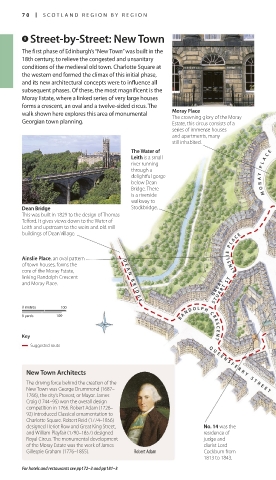
9 Street-by-Street: New Town . The Georgian House
No. 7 is owned by the National Trust
The first phase of Edinburgh’s “New Town” was built in the for Scotland and is open to the
public. It has been repainted in its
18th century, to relieve the congested and unsanitary original colours and furnished with
conditions of the medieval old town. Charlotte Square at appropriate antiques, and is a
the western end formed the climax of this initial phase, testament to the lifestyle of the
and its new architectural concepts were to influence all upper sector of 18th-century
subsequent phases. Of these, the most magnificent is the Edinburgh society.
Moray Estate, where a linked series of very large houses Locator Map
forms a crescent, an oval and a twelve-sided circus. The See Edinburgh Map pp58–9
walk shown here explores this area of monumental Moray Place
The crowning glory of the Moray
Georgian town planning. Estate, this circus consists of a
series of immense houses
and apartments, many Bute House is the official
still inhabited. residence of the First Minister of
The Water of the Scottish Parliament.
A C E
Leith is a small A C E M
river running P P L L O
through a R
de lightful gorge A Y A Y A Y H E R I O T R O W
below Dean R R D A R N A W A Y S T
P
Bridge. There O O L
is a riverside M M A C E
walkway to
Dean Bridge Stockbridge. W E M Y S S P L A C E
This was built in 1829 to the design of Thomas York Place
Telford. It gives views down to the Water of
Leith and upstream to the weirs and old mill F O R E S T S T R E E T Q U E E N S T R E E T
buildings of Dean Village.
A I N S L I E P L A C E S T C O L M E C The square was built between 1792
. Charlotte Square
S T R E E
Ainslie Place, an oval pattern D S T R E E T T and 1811 to provide a series of lavish
of town houses, forms the E town houses for the most successful
core of the Moray Estate, A N N O R T H city mer chants. Most of the buildings
linking Randolph Crescent S T C O L M E H A R L O T T E S T are now used as offices.
G R E A T
and Moray Place. B R
I D G S T U A R T S T No. 39 Castle Street was
C H A R L O T T E S Q U A R
0 metres 100 E C H A R L O T T E S Q U A R E E G E O R G E S T R E E T the home of the writer Sir
Walter Scott (see p92).
0 yards 100
Key R A N D O L P H C R E S C E N T C A S T L E S T R E E T
Suggested route
C H A R L O T T E S Q U A R E
New Town Architects Q U E E N S F E R R Y S T R E E H O C H A R L O T T E S T
P
The driving force behind the creation of the E
S O U T H
New Town was George Drummond (1687– S T P R I N C E S S T R E E T
Q U E E N S F E R R Y S T R E E T T
1766), the city’s Provost, or Mayor. James R
Craig (1744–95) won the overall design E
competition in 1766. Robert Adam (1728– T
E
92) introduced Classical ornamentation to
Charlotte Square. Robert Reid (1774–1856)
designed Heriot Row and Great King Street, No. 14 was the Princes Street Gardens
and William Playfair (1790–1857) designed residence of No. 9 was the home of surgeon Princes Street was part of the
Royal Circus. The monumental development judge and Joseph Lister (see p29) from 1870 initial building phase of the
of the Moray Estate was the work of James diarist Lord West Register House was to 1877. He developed methods New Town. The north side is
Gillespie Graham (1776–1855). Robert Adam Cockburn from originally St George’s Church, of preventing infection both lined with shops; the gardens
1813 to 1843. designed by Robert Adam. during and after surgery. to the south lie below the castle.
For hotels and restaurants see pp172–3 and pp181–3
070-071_EW_Scotland.indd 70 10/23/17 11:55 AM 070-071_EW_Scotland.indd 71 10/23/17 11:55 AM

