


Page 53 - All About History - Issue 59-17
P. 53
London’s Lost Frost Fairs


 Frost Fairs


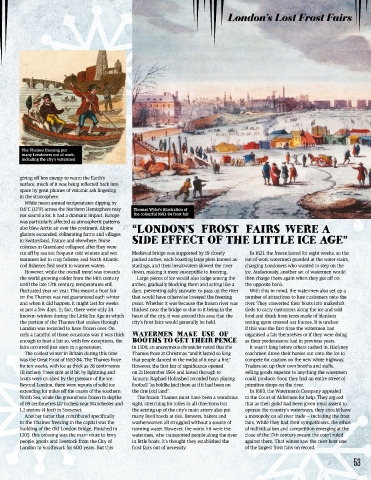
         The Thames freezing put
         many Londoners out of work,
         including the city’s watermen


        giving off less energy to warm the Earth’s
        surface, much of it was being reflected back into
        space by great plumes of volcanic ash lingering
        in the stratosphere.
          While mean annual temperatures dipping by
        0.6°C (1.1°F) across the Northern Hemisphere may   Thomas Wyke’s illustration of
        not sound a lot, it had a dramatic impact. Europe   the colourful 1683-84 frost fair
        was particularly affected as atmospheric patterns
        also blew Arctic air over the continent. Alpine   “LOnDOn’s  frOsT  fairs wErE a
        glaciers expanded, obliterating farms and villages
        in Switzerland, France and elsewhere; Norse   siDE EffEcT Of THE LiTTLE icE agE”
        colonies in Greenland collapsed after they were
        cut off by sea ice; frequent cold winters and wet   Medieval bridge was supported by 19 closely   In 1621, the freeze lasted for eight weeks, so the
        summers led to crop failures; and North Atlantic   packed arches, each boasting large piers known as   out-of-work watermen guarded at the water-stairs,
        cod fisheries fled south to warmer waters.  starlings, and their breakwaters slowed the river   charging Londoners who wanted to step on the
          However, while the overall trend was towards   down, making it more susceptible to freezing.  ice. Audaciously, another set of watermen would
        the world growing colder from the 14th century   Large pieces of ice would also lodge among the   then charge them again when they got off on
        until the late 17th century, temperatures still   arches, gradually blocking them and acting like a   the opposite bank.
        fluctuated year on year. This meant a frost fair   dam, preventing salty seawater to pass up the river   With this in mind, the watermen also set up a
        on the Thames was not guaranteed each winter   that would have otherwise lowered the freezing   number of attractions to lure customers onto the
        and when it did happen, it might last for weeks   point. Whether it was because the frozen river was   river. They converted their boats into makeshift
        or just a few days. In fact, there were only 24   thickest near the bridge or due to it being in the   sleds to carry customers along the ice and sold
        known› winters during the Little Ice Age in which   heart of the city, it was around this area that the   food and drink from tents made of blankets
        the portion of the Thames that snakes through   city’s frost fairs would generally be held.  resting upon crossed oar frames. It is unclear
        London was recorded to have frozen over. On                                    if this was the first time the watermen had
        only a handful of those occasions was it was thick  waTErmEn makE usE  Of      organised a fair themselves or if they were doing
        enough to host a fair so, with few exceptions, the   BOOTHs TO gET THEir PEncE  as their predecessors had in previous years.
        fairs occurred just once in a generation.  In 1309, an anonymous chronicler noted that the   It wasn’t long before others cashed in. Hackney
          The coldest winter in Britain during this time   Thames froze at Christmas “and it lasted so long   coachmen drove their horses out onto the ice to
        was the Great Frost of 1683-84. The Thames froze   that people danced in the midst of it near a fire.”   compete for custom on the new white highway.
        for ten weeks, with ice as thick as 28 centimetres   However, the first fair of significance opened    Traders set up their own booths and stalls,
        (11 inches). Trees split as if hit by lightning and   on 21 December 1564 and lasted through to   selling goods superior to anything the watermen
        boats were crushed by the pressure of the ice.    January. Raphael Holinshed recorded boys playing   could produce. Soon they had an entire street of
        Beyond London, there were reports of solid ice   football “as boldlie [sic] there as if it had been on   primitive shops on the river.
        extending for miles off the coasts of the southern   the drie [sic] land”.       In 1683, the Watermen’s Company appealed
        North Sea, while the ground was frozen to depths   The frozen Thames must have been a wondrous   to the Court of Aldermen for help. They argued
        of 69 centimetres (27 inches) near Manchester and   sight, stretching for miles in all directions but   that as their guild had been given royal assent to
        1.2 metres (4 feet) in Somerset.       the seizing up of the city’s main artery also put   operate the country’s waterways, they should have
          Another factor that contributed specifically   many livelihoods at risk. Brewers, bakers and   a monopoly on all river trade — including the frost
        to the Thames freezing in the capital was the   washerwomen all struggled without a source of   fairs. While they had their sympathisers, the ethos
        building of the Old London Bridge. Finished in   running water. However, the worst hit were the   of individualism and competition emerging at the
        1205, this crossing was the main route to ferry   watermen, who transported people along the river   close of the 17th century meant the court ruled
        people, goods and livestock from the City of   in little boats. It’s thought they established the   against them. That winter saw the river host one
        London to Southwark for 600 years. But this   frost fairs out of necessity.    of the largest frost fairs on record.

                                                                                                                             53

