


Page 58 - All About History - Issue 59-17
P. 58
Time Traveller’s Handbook


                Colonial


                Brazil                                        Brazil, 17th century           Dos & don’ts


                    ortuguese explorer Pedro Álvares Cabral planted the nation’s flag on the Brazilian shore   Sleep in a hammock.
                    as early as 1500, but over 100 years later only a few trading posts have been established   Keeping off the forest floor at
                    on the east coast. While the Portuguese                                         night is the only way to avoid
                PEmpire focuses on expansion into                                             being eaten alive by insects.
                India and the Far East, Brazil has been
                divided into 15 captaincies that are run                                            Wear thick clothing.
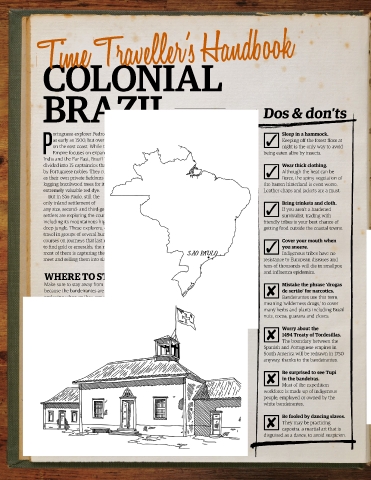
                by Portuguese nobles. They run these                            Fig.01              Although the heat can be
                as their own private fiefdoms while                                                 fierce, the spiny vegetation of
                logging brazilwood trees for its                                              the barren hinterland is even worse.
                extremely valuable red dye.                                                   Leather chaps and jackets are a must.
                  But in São Paulo, still the
                only inland settlement of                                                           Bring trinkets and cloth.
                any size, second- and third-generation         Brazil                               If you aren’t a hardened
                settlers are exploring the country’s interior,                                      survivalist, trading with
                including its mountainous highlands and                                       friendly tribes is your best chance of
                deep jungle. These explorers, or bandeirantes,                                getting food outside the coastal towns.
                travel in groups of several hundred, following the river
                courses on journeys that last months or years. Hoping                               Cover your mouth when
                to find gold or emeralds, the main source of wealth for                             you sneeze.
                most of them is capturing the indigenous Tupi they   SãO PaUlO                      Indigenous tribes have no
                meet and selling them into slavery.                                           resistance to European diseases and
                                                                                              tens of thousands will die in smallpox
                 Where To STay                                                                and influenza epidemics.

                 Make sure to stay away from the indigenous villages                                Mistake the phrase ‘drogas
                 because the bandeirantes are actively hunting down tribes,                         de sertão’ for narcotics.
                 enslaving whoever they can and exterminating the rest.                             Bandeirantes use this term,
                 This means that many of the indigenous people are hostile                    meaning ’wilderness drugs,’ to cover
                 to outsiders, even leading their own raiding parties.                        many herbs and plants including Brazil
                  Jesuit missionaries have set up fortified communities                       nuts, cocoa, guarana and cloves.
                 known as ‘reductions’ to try and protect the natives. But the
                 slavers are growing increasingly brazen and have                                   Worry about the
                 even started attacking these refugee camps. São                                    1494 Treaty of Tordesillas.
                 Paulo is your safest option. This future megacity is                               The boundary between the
                 still a very poor frontier town, notable only for its                        Spanish and Portuguese empires in
                 large Jesuit college, but it is well defended.                               South America will be redrawn in 1750
                                                                                              anyway, thanks to the bandeirantes.

                                                                          Fig.02
                                                                                                    Be surprised to see Tupi
                                                                                                    in the bandeiras.
                                                                                                    Most of the expedition
                                                                                              workforce is made up of indigenous
                                                                                              people, employed or owned by the
                                                                                              white bandeirantes.
                                                                                                    Be fooled by dancing slaves.
                                                                                                    They may be practicing
                                                                                                    capoeira, a martial art that is
                                                                                              disguised as a dance, to avoid suspicion.

               58

