


Page 57 - All About History - Issue 59-17
P. 57
London’s Lost Frost Fairs


                                               impermanent, so it was understood to only be a   Forever’. At least ten printers were set up and sold
                                               temporary suspension of social etiquette.  books with their postcards and poems while a
                                                 Despite the behaviour the fairs encouraged,   full-blown casino offered roulette and a wheel of
                                               even royalty couldn’t resist. Queen Elizabeth I   fortune. The watermen assumed their old position,
                                               walked upon the ice daily in 1564 to “shoot a few   charging two- or threepence for safe passage onto
                                               marks” with bow and arrow. King Charles II went   the ice. As the Londoners descended onto the
                                               one step further at the Blanket Fair, attending with   frozen Thames en masse once more, a group of 70
                                               some of the royal family to see “Great Britain’s   people reportedly walked across the frozen water
                                               wonder” on 31 January 1684. He even bought   to South Bank all at once.
                                               a memento from one of the printers, stamped   Various modern accounts claim an elephant
                                               with the date and their names. A French account   walked across the ice at the final fair. While we
                                               claimed the Merry Monarch spent a whole night   would like to say this was led by a descendent
                                               at the fair, while others say he joined in a foxhunt   of the Blanket Fair’s James William Chipperfield,
                                               on the ice. Perhaps while accompanying the king,   whose family’s circus was now a booming success,
                                               the royal army also fired a ceremonial salute with   the story may sadly be apocryphal. There are no
                                               several cannons on the ice.             known records from 1814 mentioning the animal,
                                                                                       which would surely have been a talking point.
                                               sEE wHaT THings uPOn                      The fair lasted just four days as so many people
                                               THE icE wErE DOnE                       and milder temperatures caused cracks to quickly
                                               There were more frost fairs in the 18th century and   appear in the ice. More than one person drowned
                                               they offered much the same attractions. In 1715,   and booths were carried away on ice flows.
                                               live entertainment was provided by “Will Ellis the   Damage to river barges was estimated at some
                                               Poet and his wife Bess” who were “Rhiming [sic]   £20,000, caused by giant fast-flowing chunks that
        bowling and hoopla, Londoners enjoyed the dizzy   on the Hard Frost.” Ox was again roasted by a Mr   had broken up. But even then, a large printing
        experience of a ‘Dutch whimsie’ — being spun   Atkins and Mr Hodginson, who claimed to be the   press, hungry for profits, was set up in defiance on
        around in a chair or a boat tied to a pole. Every   descendents of the gentleman who had done the   an ice island near Westminster.
        roundabout in modern playgrounds is thought to be   same in 1684. The painter William Hogarth bought   The Thames did freeze again after 1814 but
        a descendent of this “whirling sledge”.  a souvenir print for his pet pug, Trump. However,   not to the extent that anyone could walk on it.
          John Evelyn called the 1684 fair a “bacchanalian   these later fairs also saw greater mechanisation, so   The Little Ice Age was drawing to a close, ending
        triumph, or carnival on the water”, while his   the fairground attractions looked more like today’s   after 1850, but the frost fairs were also a victim
        equally prudish contemporary Roger Morrice   with swing sets and — sources claim — some sort   of progress. The Old London Bridge was beyond
        complained, “All manner of debauchery upon   of clockwork car went on display.   repair and had to be replaced in 1830 by the
        the Thames continued upon the Lord’s Day and   The final fair was held in February 1814 and   modern London Bridge. This, plus the creation
        Monday”. Fair-goers could gamble and likely   though it only lasted a few days, it went out in   of the Embankment in the 19th century, created
        placed wagers on regular attractions like horse   style. The ice followed a thick fog that enveloped   a narrower, faster-flowing Thames that was less
        racing and blood sports. As well as seeing bears   the city and the surrounding country, allegedly   likely to freeze.
        and bulls fight dogs, “throwing at cocks” was   lasting from 27 December 1813 to 3 January 1814.  London’s lost frost fairs were always a
        promoted at the 1684 fair. This involved a rooster   Once it cleared, a grand mall was set-up by   celebration of impermanence, with participants
        being tied to a post and participants taking turns   Blackfriars Bridge, dubbed ‘City Street’, boasting   never sure when the party would be over or when
        to throw weighted sticks at the bird until it died.  temporary taverns with names like ‘The City of   the floor was going to give way beneath their feet.
          Prostitutes also ambled among the attractions,   Moscow’, ‘The Free and Easy’ and ‘Wellington   We could never expect them to last forever.
        soliciting customers. The beleaguered watermen
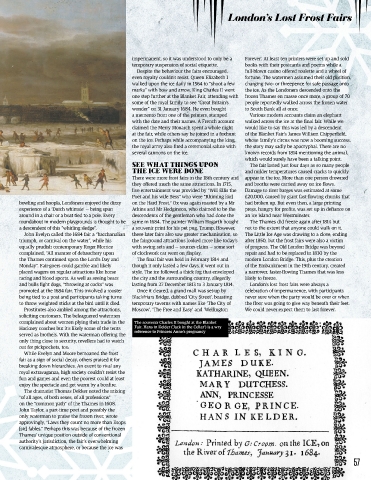
        complained about women plying their trade in the   The souvenir Charles II bought at the Blanket
        Hackney coaches but it’s likely some of the tents   Fair. Hans in Kelder (‘Jack in the Cellar’) is a wry
        served as brothels. With the waterman offering the   reference to Princess Anne’s pregnancy
        only thing close to security, revellers had to watch
        out for pickpockets, too.
          While Evelyn and Moore bemoaned the frost
        fair as a sign of social decay, others praised it for
        breaking down hierarchies. An event to rival any
        royal extravaganza, high society couldn’t resist the
        fun and games and even the poorest could at least
        enjoy the spectacle and get warm by a bonfire.
          The dramatist Thomas Dekker noted the mixing
        “of all ages, of both sexes, of all professions”
        on the “common path” of the Thames in 1608.
        John Taylor, a part-time poet and possibly the
        only waterman to praise the frozen river, wrote
        approvingly, “Laws they count no more than Esops
        [sic] fables.” Perhaps this was because of the frozen
        Thames’ unique position outside of conventional
        authority’s jurisdiction, the fair’s overwhelming
        carnivalesque atmosphere, or because the ice was

                                                                                                                             57

