


Page 158 - (DK) The Business Book
P. 158
156


                                                 AS THE ROLE OF


                                            PRIVATE EQUITY HAS


                                              GROWN, SO HAVE


                                               THE RISKS IT POSES


                                         THE PRIVATE EQUITY MODEL


                                                                                ome economists believe
          IN CONTEXT                                                            that “private equity” is
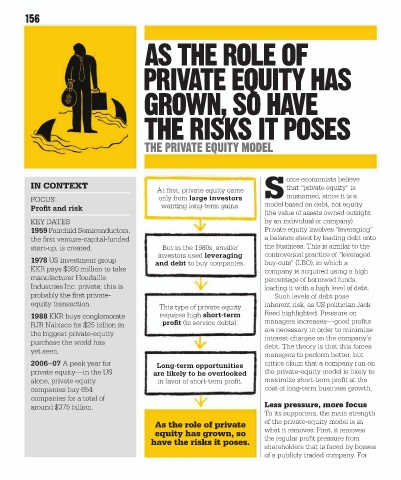
                                            At first, private equity came
          FOCUS                              only from large investors    S misnamed, since it is a
                                                                          model based on debt, not equity
          Profit and risk                     wanting long-term gains.
                                                                          (the value of assets owned outright
          KEY DATES                                                       by an individual or company).
          1959 Fairchild Semiconductors,                                  Private equity involves “leveraging”
          the first venture-capital-funded                                 a balance sheet by loading debt onto
          start-up, is created.               But in the 1980s, smaller   the business. This is similar to the
                                             investors used leveraging    controversial practice of “leveraged
          1978 US investment group
                                            and debt to buy companies.    buy-outs” (LBO), in which a
          KKR pays $380 million to take                                   company is acquired using a high
          manufacturer Houdaille                                          percentage of borrowed funds,
          Industries Inc. private; this is                                loading it with a high level of debt.
          probably the first private-                                         Such levels of debt pose
          equity transaction.                                             inherent risk, as US politician Jack
                                             This type of private equity
          1988 KKR buys conglomorate         requires high short-term     Reed highlighted. Pressure on
          RJR Nabisco for $25 billion in      profit (to service debts).   managers increases—good profits
                                                                          are necessary in order to minimize
          the biggest private-equity
                                                                          interest charges on the company’s
          purchase the world has
                                                                          debt. The theory is that this forces
          yet seen.
                                                                          managers to perform better, but
          2006–07 A peak year for           Long-term opportunities       critics claim that a company run on
          private equity—in the US         are likely to be overlooked    the private-equity model is likely to
          alone, private equity             in favor of short-term profit.  maximize short-term profit at the
          companies buy 654                                               cost of long-term business growth.
          companies for a total of
                                                                          Less pressure, more focus
          around $375 billion.
                                                                          To its supporters, the main strength
                                            As the role of private        of the private-equity model is in
                                            equity has grown, so          what it removes. First, it removes
                                           have the risks it poses.       the regular profit pressure from
                                                                          shareholders that is faced by bosses
                                                                          of a publicly traded company. For

