


Page 191 - (DK) The Business Book
P. 191
WORKING WITH A VISION         189

        See also: Managing risk 40–41   ■  Hubris and nemesis 100–03   ■  Learning from   Supplier roles in crisis
        failure 164–65   ■  Contingency planning 210   ■  Coping with chaos 220–21
                                                                            In their article “The Toyota
                                                                            Group and the Aisin Fire,”
                                         be minimized and its reputation
                                                                            authors Toshihiro Nishiguchi
                                         even enhanced. As president John
                                                                            and Alexandre Beaudet
                                         F Kennedy said, “in Chinese, the   demonstrated the importance
                                         word ‘crisis’ is composed of two   of supplier relationships
                                         characters—one represents danger   during a crisis. In 1997, a fire
                                         and one represents opportunity.”   at the plant of one of Toyota’s
                                                                            most trusted suppliers, Aisin
                                         Handling a crisis                  Seiki, threatened to halt
                                         In 1982, Johnson & Johnson reacted   Toyota-group operations for
                                         to a crisis effectively when Tylenol   weeks. Aisin Seiki was the
                                         pain-relief capsules sold in the   sole source for a small but
                                         Chicago, IL, area had been laced   crucial part used in all Toyota
                                         with cyanide. The company recalled   vehicles. Only two or three
                                                                            days’ worth of stock was on
                                         the product, stopped advertising, and
                                                                            hand. Toyota’s manufacturing
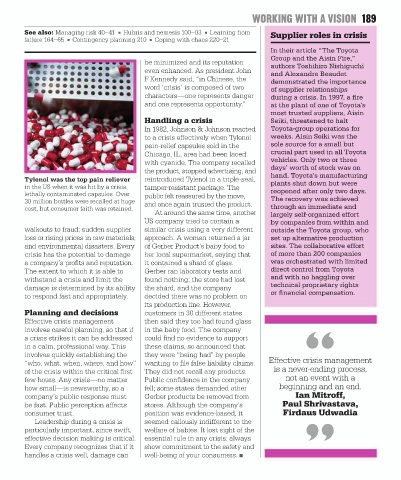
        Tylenol was the top pain reliever    reintroduced Tylenol in a triple-seal,   plants shut down but were
        in the US when it was hit by a crisis:   tamper-resistant package. The
        lethally contaminated capsules. Over   public felt reassured by the move,   reopened after only two days.
        30 million bottles were recalled at huge   and once again trusted the product.  The recovery was achieved
        cost, but consumer faith was retained.                              through an immediate and
                                            At around the same time, another   largely self-organized effort
                                         US company tried to contain a      by companies from within and
        walkouts to fraud; sudden supplier   similar crisis using a very different   outside the Toyota group, who
        loss or rising prices in raw materials;  approach. A woman returned a jar    set up alternative production
        and environmental disasters. Every   of Gerber Product’s baby food to    sites. The collaborative effort
        crisis has the potential to damage    her local supermarket, saying that   of more than 200 companies
        a company’s profits and reputation.   it contained a shard of glass.   was orchestrated with limited
        The extent to which it is able to   Gerber ran laboratory tests and   direct control from Toyota
        withstand a crisis and limit the   found nothing; the store had lost   and with no haggling over
                                                                            technical proprietary rights
        damage is determined by its ability   the shard, and the company
                                                                            or financial compensation.
        to respond fast and appropriately.   decided there was no problem on
                                         its production line. However,
        Planning and decisions           customers in 30 different states
        Effective crisis management      then said they too had found glass
        involves careful planning, so that if    in the baby food. The company
        a crisis strikes it can be addressed   could find no evidence to support
        in a calm, professional way. This   these claims, so announced that
        involves quickly establishing the   they were “being had” by people
                                                                           Effective crisis management
        “who, what, when, where, and how”  wanting to file false liability claims.
                                                                            is a never-ending process,
        of the crisis within the critical first   They did not recall any products.
        few hours. Any crisis—no matter   Public confidence in the company       not an event with a
        how small—is newsworthy, so a    fell; some states demanded other     beginning and an end.
        company’s public response must    Gerber products be removed from         Ian Mitroff,
        be fast. Public perception affects   stores. Although the company’s    Paul Shrivastava,
        consumer trust.                  position was evidence-based, it       Firdaus Udwadia
           Leadership during a crisis is   seemed callously indifferent to the
        particularly important, since swift,   welfare of babies. It lost sight of the
        effective decision making is critical.  essential rule in any crisis: always
        Every company recognizes that if it   show commitment to the safety and
        handles a crisis well, damage can   well-being of your consumers. ■

