


Page 31 - (DK) The Business Book
P. 31
START SMALL, THINK  BIG          29

        See also: Finding a profitable niche 22–23   ■  Gaining an edge 32–39   ■  Reinventing and adapting 52–57   ■  Porter’s generic
        strategies 178–83   ■  Good and bad strategy 184–85   ■  The value chain 216–17


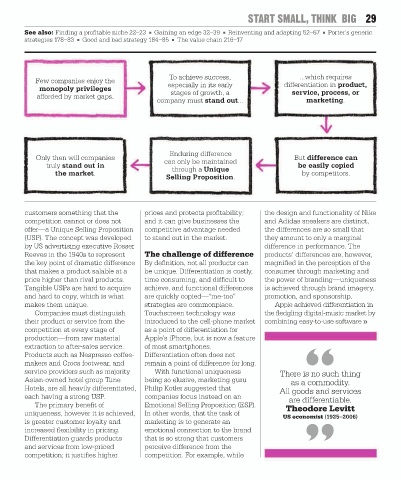
                                                To achieve success,                 ...which requires
           Few companies enjoy the
                                               especially in its early         differentiation in product,
            monopoly privileges                                                  service, process, or
           afforded by market gaps.             stages of growth, a
                                            company must stand out...                marketing.


                                                Enduring difference
           Only then will companies           can only be maintained              But difference can
              truly stand out in                through a Unique                   be easily copied
                the market.                                                         by competitors.
                                               Selling Proposition.


        customers something that the     prices and protects profitability;   the design and functionality of Nike
        competition cannot or does not   and it can give businesses the   and Adidas sneakers are distinct,
        offer—a Unique Selling Proposition   competitive advantage needed    the differences are so small that
        (USP). The concept was developed   to stand out in the market.    they amount to only a marginal
        by US advertising executive Rosser                                difference in performance. The
        Reeves in the 1940s to represent   The challenge of difference    products’ differences are, however,
        the key point of dramatic difference   By definition, not all products can   magnified in the perception of the
        that makes a product salable at a   be unique. Differentiation is costly,   consumer through marketing and
        price higher than rival products.   time consuming, and difficult to   the power of branding—uniqueness
        Tangible USPs are hard to acquire   achieve, and functional differences   is achieved through brand imagery,
        and hard to copy, which is what   are quickly copied—“me-too”     promotion, and sponsorship.
        makes them unique.               strategies are commonplace.         Apple achieved differentiation in
           Companies must distinguish    Touchscreen technology was       the fledgling digital-music market by
        their product or service from the   introduced to the cell-phone market   combining easy-to-use software ❯❯
        competition at every stage of    as a point of differentiation for
        production—from raw material     Apple’s iPhone, but is now a feature
        extraction to after-sales service.   of most smartphones.
        Products such as Nespresso coffee-  Differentiation often does not
        makers and Crocs footwear, and   remain a point of difference for long.
        service providers such as majority   With functional uniqueness       There is no such thing
        Asian-owned hotel group Tune     being so elusive, marketing guru        as a commodity.
        Hotels, are all heavily differentiated,  Philip Kotler suggested that   All goods and services
        each having a strong USP.        companies focus instead on an           are differentiable.
           The primary benefit of         Emotional Selling Proposition (ESP).   Theodore Levitt
        uniqueness, however it is achieved,   In other words, that the task of
                                                                               US economist (1925–2006)
        is greater customer loyalty and   marketing is to generate an
        increased flexibility in pricing.   emotional connection to the brand
        Differentiation guards products    that is so strong that customers
        and services from low-priced     perceive difference from the
        competition; it justifies higher   competition. For example, while

