


Page 38 - (DK) The Business Book
P. 38
36 36 GAINING AN EDGE


                                         research has indicated that      from entering a proven market.
                                         significant advantages accrue     They are also able to avoid costly
                                         to market pioneers, which can be   investment in risky and potentially
                                         directly attributable to the timing   flawed processes or technologies;
                                         of entry. The irony is that in a   first-movers, by contrast, may have
                                         retrospective paper that appeared   accrued significant “sunk costs”
                                         in 1998, “First-Mover (Dis)      (past investment) in old, less-
                                         Advantages,” Montgomery and      efficient technologies, and may be
                                         Lieberman themselves backed off   less able to adapt as the industry
                                         their original claims concerning    matures. Followers can enter at
                                         the benefits of being the first to   the point at which technology
                                         enter a market.                  and processes are relatively well
                                            Building on the work of, among   established, with both cost and
                                         others, US academics Peter Golder   risks being lower.
                                         and Gerard Tellis in 1993,          Followers may have to fight
                                         Montgomery and Lieberman’s 1998   to overcome the first-movers’
                                         paper questioned the entire notion   brand loyalty, but simply offering
                                         of first-mover advantage. In their   a superior product that better
                                         research, Golder and Tellis had   addresses customer needs is
                                         found that almost half the first-  often sufficient to secure a market.
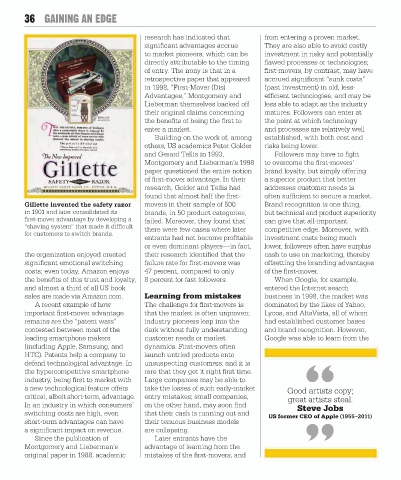
        Gillette invented the safety razor   movers in their sample of 500   Brand recognition is one thing,
        in 1901 and later consolidated its   brands, in 50 product categories,   but technical and product superiority
        first-mover advantage by developing a   failed. Moreover, they found that   can give that all-important
        “shaving system” that made it difficult   there were few cases where later   competitive edge. Moreover, with
        for customers to switch brands.
                                         entrants had not become profitable   investment costs being much
                                         or even dominant players—in fact,   lower, followers often have surplus
        the organization enjoyed created   their research identified that the   cash to use on marketing, thereby
        significant emotional switching   failure rate for first-movers was    offsetting the branding advantages
        costs; even today, Amazon enjoys   47 percent, compared to only    of the first-mover.
        the benefits of this trust and loyalty,  8 percent for fast followers.  When Google, for example,
        and almost a third of all US book                                 entered the Internet search
        sales are made via Amazon.com.   Learning from mistakes           business in 1998, the market was
           A recent example of how       The challenge for first-movers is   dominated by the likes of Yahoo,
        important first-mover advantage   that the market is often unproven;   Lycos, and AltaVista, all of whom
        remains are the “patent wars”    industry pioneers leap into the    had established customer bases
        contested between most of the    dark without fully understanding   and brand recognition. However,
        leading smartphone makers        customer needs or market         Google was able to learn from the
        (including Apple, Samsung, and   dynamics. First-movers often
        HTC). Patents help a company to   launch untried products onto
        defend technological advantage. In   unsuspecting customers; and it is
        the hypercompetitive smartphone   rare that they get it right first time.
        industry, being first to market with   Large companies may be able to
        a new technological feature offers   take the losses of such early-market
                                                                                Good artists copy;
        critical, albeit short-term, advantage.  entry mistakes; small companies,
                                                                                great artists steal.
        In an industry in which consumers’   on the other hand, may soon find       Steve Jobs
        switching costs are high, even   that their cash is running out and
                                                                           US former CEO of Apple (1955–2011)
        short-term advantages can have    their tenuous business models
        a significant impact on revenue.  are collapsing.
           Since the publication of         Later entrants have the
        Montgomery and Lieberman’s       advantage of learning from the
        original paper in 1988, academic   mistakes of the first-movers, and

