


Page 40 - (DK) The Business Book
P. 40
38 38 GAINING AN EDGE


        significant. They give the example   have enjoyed short-lived advantage
        of the market for vacuum cleaners,   but in dynamic markets such an
        and, in particular, of the long-term   advantage is rarely durable. Even
        market leader, Hoover. Until the   Apple, who enjoyed significant
        relatively recent introduction of   early-entrant advantage in the
        Dyson cleaners, the market was   smartphone market with the            If you do things well,
        benign and technological         iPhone, is not immune from first-         do them better.
        advancement slow. Having been    mover disadvantage. Competitors,        Anita Roddick
        first to market in 1908, Hoover   Samsung in particular, were able     UK entrepreneur (1942–2007)
        enjoyed several decades of       to listen to customer complaints
        advantage—an advantage that      about iPhones, analyze customer
        was (and, in some places, still is)   needs, and produce products with
        reflected in the widespread use of   features and functionality welcomed
        the company’s brand name as the   by the market. Apple, locked into
        verb “to hoover.”                previous technology iterations, took
           In other industries, however,   time to react and iPhone sales   importantly, the organization
        where technological change or    suffered as a result.            insists on a deep understanding of
        market evolution is rapid, first-                                  customer needs in any market they
        movers are often at a disadvantage.  Customer needs               enter. In other words, they would
        The first search engines are      To gain an edge, therefore, you do   rather enter mature markets than
        examples of businesses that had   not always need to be first. Indeed,   be first into new ones.
        too much invested in early       US multinational Procter & Gamble,   The company values long-term
        iterations of a technology to keep   for example, prefers only to enter   relationships with its customers
        up with the rapid pace of change.   those markets in which it can   and suppliers; its view of innovation
           Early advantage quickly       establish a strong number one or   is different from small companies
        becomes obsolete in changeable   number two position over the long-  who, in attempting to capture
        markets. As the market evolves,   term—rarely is this achieved in a   market share, strive to gain an
        later entrants are those that seem   blind rush to be first.       edge through the introduction of
        to be cutting edge, offering        Procter & Gamble seeks        disruptive technology—innovative
        innovative features that build on   markets that are demographically   technology that seeks to destabilize
        the market-knowledge as well as   and structurally attractive, with   the existing market. Procter &
        learning from the mistakes of the   lower capital requirements, and   Gamble, perhaps heeding the
        first-mover. The first-mover may   higher margins. But most         research, considers such strategies
                                                                          to be short-lived. They realize that
                                                                          overly rapid innovation runs the risk
                                                                          of cannibalizing their own sales
                                                                          and reducing the returns on new
                                                                          product investment. In the market
                                                                          for disposable baby diapers, for
                                                                          example, Procter & Gamble was
                                                                          more than ten years behind the first
                                                                          mover. The company’s now famous
                                                                          Pampers brand was launched in
                                                                          1961, following some way behind
                                                                          Johnson & Johnson’s Chux brand,


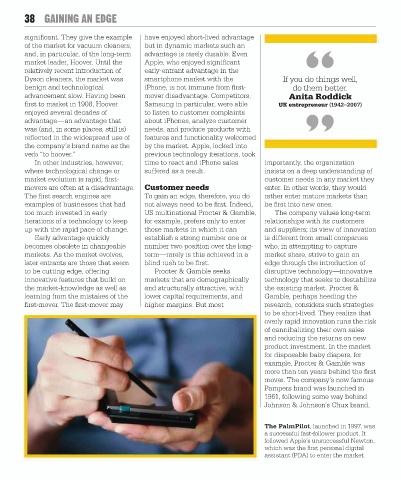
                                                                          The PalmPilot, launched in 1997, was
                                                                          a successful fast-follower product. It
                                                                          followed Apple’s unsuccessful Newton,
                                                                          which was the first personal digital
                                                                          assistant (PDA) to enter the market.

