


Page 59 - (DK) The Business Book
P. 59
START SMALL, THINK BIG          57


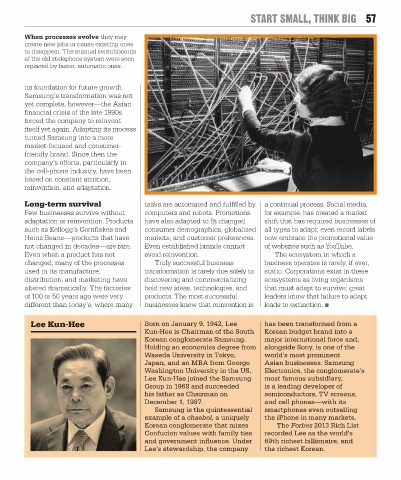
        When processes evolve they may
        create new jobs or cause existing ones
        to disappear. The manual switchboards
        of the old ztelephone system were soon
        replaced by faster, automatic ones.


        its foundation for future growth.
        Samsung’s transformation was not
        yet complete, however—the Asian
        financial crisis of the late 1990s
        forced the company to reinvent
        itself yet again. Adapting its process
        turned Samsung into a more
        market-focused and consumer-
        friendly brand. Since then the
        company’s efforts, particularly in
        the cell-phone industry, have been
        based on constant attrition,
        reinvention, and adaptation.

        Long-term survival               tasks are automated and fulfilled by  a continual process. Social media,
        Few businesses survive without   computers and robots. Promotions   for example, has created a market
        adaptation or reinvention. Products   have also adapted to fit changed   shift that has required businesses of
        such as Kellogg’s Cornflakes and   consumer demographics, globalized  all types to adapt; even record labels
        Heinz Beans—products that have   markets, and customer preferences.   now embrace the promotional value
        not changed in decades—are rare.   Even established brands cannot   of websites such as YouTube.
        Even when a product has not      avoid reinvention.                  The ecosystem in which a
        changed, many of the processes      Truly successful business     business operates is rarely, if ever,
        used in its manufacture,         transformation is rarely due solely to   static. Corporations exist in these
        distribution, and marketing have   discovering and commercializing   ecosystems as living organisms
        altered dramatically. The factories   bold new ideas, technologies, and   that must adapt to survive; great
        of 100 or 50 years ago were very   products. The most successful   leaders know that failure to adapt
        different than today’s, where many   businesses know that reinvention is   leads to extinction. ■

          Lee Kun-Hee                    Born on January 9, 1942, Lee     has been transformed from a
                                         Kun-Hee is Chairman of the South   Korean budget brand into a
                                         Korean conglomerate Samsung.     major international force and,
                                         Holding an economics degree from  alongside Sony, is one of the
                                         Waseda University in Tokyo,      world’s most prominent
                                         Japan, and an MBA from George    Asian businesses. Samsung
                                         Washington University in the US,   Electronics, the conglomerate’s
                                         Lee Kun-Hee joined the Samsung   most famous subsidiary,
                                         Group in 1968 and succeeded      is a leading developer of
                                         his father as Chairman on        semiconductors, TV screens,
                                         December 1, 1987.                and cell phones—with its
                                            Samsung is the quintessential   smartphones even outselling
                                         example of a chaebol, a uniquely   the iPhone in many markets.
                                         Korean conglomerate that mixes       The Forbes 2013 Rich List
                                         Confucian values with family ties   recorded Lee as the world’s
                                         and government influence. Under   69th richest billionaire, and
                                         Lee’s stewardship, the company   the richest Korean.

