


Page 61 - (DK) The Business Book
P. 61
START SMALL, THINK BIG          59

        See also: Beating the odds at start-up 20–21   ■  Take the second step 43   ■  How fast to grow 44–45   ■  From entrepreneur to
        leader 46–47   ■  Keep evolving business practice 48–51   ■  The weightless start-up 62–63


                                                                                    These crises are
                Start-ups are                      ...but growth                 predictable and can
              exciting places                    brings inevitable
                                                                                 be managed by using
                  to work...                         crises.
                                                                                   the Greiner Curve.


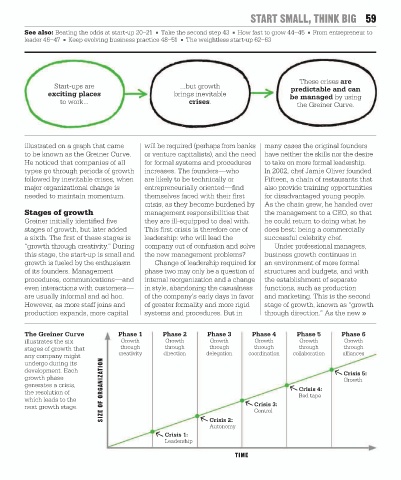
        illustrated on a graph that came    will be required (perhaps from banks  many cases the original founders
        to be known as the Greiner Curve.    or venture capitalists), and the need  have neither the skills nor the desire
        He noticed that companies of all   for formal systems and procedures   to take on more formal leadership.
        types go through periods of growth   increases. The founders—who    In 2002, chef Jamie Oliver founded
        followed by inevitable crises, when   are likely to be technically or   Fifteen, a chain of restaurants that
        major organizational change is   entrepreneurially oriented—find   also provide training opportunities
        needed to maintain momentum.     themselves faced with their first   for disadvantaged young people.
                                         crisis, as they become burdened by   As the chain grew, he handed over
        Stages of growth                 management responsibilities that   the management to a CEO, so that
        Greiner initially identified five   they are ill-equipped to deal with.   he could return to doing what he
        stages of growth, but later added    This first crisis is therefore one of   does best: being a commercially
        a sixth. The first of these stages is   leadership: who will lead the   successful celebrity chef.
        “growth through creativity.” During   company out of confusion and solve   Under professional managers,
        this stage, the start-up is small and   the new management problems?  business growth continues in
        growth is fueled by the enthusiasm   Change of leadership required for  an environment of more formal
        of its founders. Management      phase two may only be a question of   structures and budgets, and with
        procedures, communications—and   internal reorganization and a change   the establishment of separate
        even interactions with customers—  in style, abandoning the casualness   functions, such as production
        are usually informal and ad hoc.   of the company’s early days in favor   and marketing. This is the second
        However, as more staff joins and   of greater formality and more rigid   stage of growth, known as “growth
        production expands, more capital   systems and procedures. But in   through direction.” As the new ❯❯


        The Greiner Curve         Phase 1     Phase 2     Phase 3      Phase 4     Phase 5     Phase 6
        illustrates the six       Growth       Growth      Growth      Growth       Growth      Growth
        stages of growth that     through     through      through     through     through      through
                                  creativity  direction   delegation  coordination  collaboration  alliances
        any company might
        undergo during its
        development. Each                                                                       Crisis 5:
        growth phase                                                                            Growth
        generates a crisis,                                                        Crisis 4:
        the resolution of    SIZE OF ORGANIZATION                                  Red tape
        which leads to the
        next growth stage.                                             Crisis 3:
                                                                       Control
                                                           Crisis 2:
                                                           Autonomy
                                              Crisis 1:
                                              Leadership
                                                                  TIME

