


Page 58 - (DK Eyewitness) Travel Guide - Vienna
P. 58
56 INTRODUCING VIENNA VIENNA A T A GLANCE 57
Vienna’s Best: Jugendstil
A stroll around Vienna’s streets will reveal the richness
of the city’s turn-of-the-century architecture. Some of
the buildings are instantly recognizable, and a few of
the public ones, such as the Secession building, are
open to visitors. However, it can be just as rewarding
to discover the lesser-known buildings and monuments Anker Clock
This clock, created by the artist
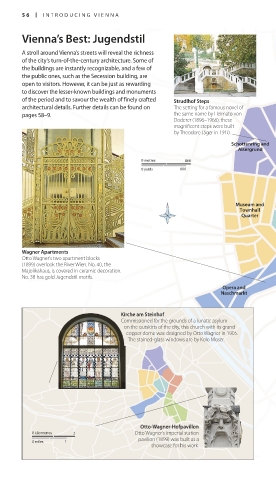
of the period and to savour the wealth of finely crafted Strudlhof Steps Franz Matsch in 1911, sits on a
architectural details. Further details can be found on The setting for a famous novel of bridge spanning two buildings on
pages 58–9. the same name by Heimato von the Hoher Markt. Every hour, on the
Doderer (1896–1966), these hour, moving figures parade across Postsparkasse
magnificent steps were built the clock face. One of Otto Wagner’s masterpieces, the
by Theodore Jäger in 1910. post office savings bank exhibits the finest
workmanship inside and out. Even the
Schottenring and Schottenring and interior ventilator shafts are by Wagner.
AlsergrundAlsergrund
0 metres 800
0 yards 800 D A N U B E C A N A L
Stadtpark Portals
Museum andMuseum and The city’s municipal park
Townhall Townhall Stephansdom is adorned with
QuarterQuarter Quarter magnificent portals
Hofburg Hofburg (1903–7), designed by
QuarterQuarter Friedrich Ohmann as
part of a project to
regulate the flow of the
River Wien.
Wagner Apartments
Otto Wagner’s two apartment blocks
(1899) overlook the River Wien. No. 40, the
Majolikahaus, is covered in ceramic decoration. Karlsplatz Pavilions
No. 38 has gold Jugendstil motifs. The two pavilions standing in
Karlsplatz were built as part of
Opera and Otto Wagner’s scheme for
Naschmarkt Vienna’s turn-of-the-century
Belvedere underground system.
Quarter
Kirche am Steinhof
Commissioned for the grounds of a lunatic asylum
on the outskirts of the city, this church with its grand
copper dome was designed by Otto Wagner in 1905.
The stained-glass windows are by Kolo Moser.
Secession Building
Nicknamed the Golden
Cabbage because of its golden
filigree dome, the Secession
Otto-Wagner-Hofpavillon Building was designed at the
0 kilometres 2 Otto Wagner’s imperial station turn of the century by Joseph
pavilion (1899) was built as a Maria Olbrich for exhibitions of
0 miles 1
showcase for his work. avant-garde art. In the
basement is Gustav Klimt’s
Beethoven Frieze.
056-057_EW_Vienna.indd 56 03/10/17 11:12 am 056-057_EW_Vienna.indd 57 03/10/17 11:12 am

