


Page 60 - (DK Eyewitness) Travel Guide - Vienna
P. 60
58 INTRODUCING VIENNA VIENNA A T A GLANCE 59
Exploring Viennese Jugendstil Furniture for radical artists and
The turn of the twentieth century saw a flowering of the visual The leading Secession designers. Hoffmann
created a number of
arts in Vienna. A new generation of avant-garde artists formed designers, such as Hoffmann houses for Secession
the Secession in 1896 and, together with architects and and Kolo Moser (1868–1918), artists in Steinfeld-
designers, forged close ties between the fine and wanted interior design to gasse. There are also
return to the simple lines of
some Jugendstil houses
decorative arts and created new Biedermeier style (see pp32–3) in Hietzing, while the
architectural styles. after the excesses of the Anker Clock by Franz
Ringstrasse era. The Austrian Matsch (1861–1942) is
The finest Museum of Applied Arts has an example of the late
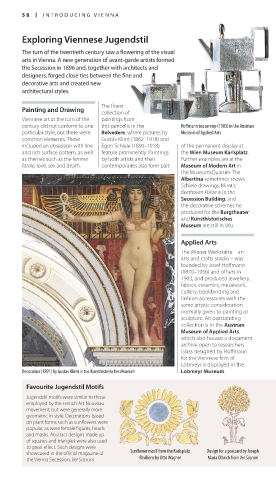
Painting and Drawing
collection of several interesting displays of flowering of the style.
Viennese art at the turn of the paintings from their work, as well as that of the Other examples of
century did not conform to one this period is in the Hoffmann tea service (1903) in the Austrian Thonet firm, which made the street architecture are
particular style, but there were Belvedere, where pictures by Museum of Applied Arts bentwood furniture admired by the Strudlhof Steps
common elements. These Gustav Klimt (1862–1918) and the Wiener Werkstätte. Furniture (1910) by Theodore
included an obsession with line Egon Schiele (1890–1918) of the permanent display at was often conceived as just one Jäger and the
and rich surface pattern, as well feature prominently. Paintings the Wien Museum Karlsplatz. element of interior design. Stadtpark Portals
as themes such as the femme by both artists and their Further examples are at the Unfortunately, many interiors by Friedrich Ohmann
fatale, love, sex and death. contemporaries also form part Museum of Modern Art in have disappeared or are not Altar in the Kirche am Steinhof (1905–7) (1858–1927) and
the MuseumsQuartier. The open to the public, but the Joseph Hackhofer
Albertina sometimes shows Wien Museum Karlsplatz, Architecture (1863–1917).
Schiele drawings. Klimt’s which also has some pieces
Beethoven Frieze is in the of Jugendstil furniture, has a Anyone walking around Vienna Finding Jugendstil
Secession Building, and recreation of Adolf Loos’s (see will notice buildings with
the decorative schemes he p94) living room. This is a rare charming Jugendstil details. Vienna
produced for the Burgtheater example of a progressive By the 1890s young architects Albertina p104
and Kunsthistorisches Viennese interior from the turn were beginning to react against Anker Clock p86
Museum are still in situ. of the century, created before the structures of the Ringstrasse Austrian Museum of Applied
the architect finally broke with era, many of which were Arts pp84–5
the Secession. pastiches of earlier historical Belvedere pp154–9
Applied Arts
styles. The leading architects Burgtheater pp134–5
The Wiener Werkstätte – an at this time were Otto Wagner Hietzing pp186–7
arts and crafts studio – was (1841–1918) and Joseph Maria Karlsplatz Pavilions pp150–51
founded by Josef Hoffmann Olbrich (1867–1908), who Kirche am Steinhof p162
(1870–1956) and others in collaborated on a number of Kunsthistorisches Museum
1903, and produced jewellery, projects, notably the design pp124–9
fabrics, ceramics, metalwork, and installation of a new city Lobmeyr Museum p107
cutlery, bookbinding and railway and its stations, the Museum of Modern Art p122
fashion accessories with the most famous examples of Otto-Wagner-Hofpavillon
same artistic consideration which are the Otto-Wagner- Pavilion p173
normally given to painting or Hofpavillon at Hietzing and the Postsparkasse p83
sculpture. An outstanding Karlsplatz Pavilions, as well as Secession Building p142
collection is in the Austrian the Wagner Apartments on Steinfeldgasse p188
Museum of Applied Arts, the Linke Wienzeile. Working Stadtpark Portals p184
which also houses a document independently, Wagner Strudlhof Steps,
archive open to researchers. produced the extraordinary Liechtensteinstrasse.
Glass designed by Hoffmann Writing desk and Kirche am Steinhof as well as Map 1 C3
for the Viennese firm of chair by Kolo Moser (1903) the Postsparkasse, while Wagner Apartments p143
Lobmeyr is displayed in the in the Austrian Museum Olbrich designed the Secession Wien Museum Karlsplatz p150
Decoration (1891) by Gustav Klimt in the Kunsthistorisches Museum Lobmeyr Museum. of Applied Arts Building as an exhibition space
Favourite Jugendstil Motifs
Jugendstil motifs were similar to those
employed by the French Art Nouveau
movement, but were generally more
geometric in style. Decorations based
on plant forms such as sunflowers were
popular, as were female figures, heads
and masks. Abstract designs made up
of squares and triangles were also used
to great effect. Such designs were
showcased in the official magazine of Sunflower motif from the Karlsplatz Design for a postcard by Joseph Design for a postcard by Joseph Gold leaf detail from the Lettering by Alfred Roller Abstract fabric design by
the Vienna Secession, Ver Sacrum. Pavilions by Otto Wagner Maria Olbrich from Ver Sacrum Maria Olbrich from Ver Sacrum Wagner Apartments from Ver Sacrum Josef Hoffmann
058-059_EW_Vienna.indd 58 03/10/17 11:00 am 058-059_EW_Vienna.indd 59 03/10/17 11:00 am
Eyewitness Travel LAYERS PRINTED:
Flashmap follow-on template “UK” LAYER
(Source v1.5)
Date 7th January 2013
Size 125mm x 217mm

