


Page 61 - (DK Eyewitness) Travel Guide - Vienna
P. 61
VIENNA A T A GLANCE 59
for radical artists and
Furniture
designers. Hoffmann
The leading Secession created a number of
designers, such as Hoffmann houses for Secession
and Kolo Moser (1868–1918), artists in Steinfeld-
wanted interior design to gasse. There are also
return to the simple lines of some Jugendstil houses
Biedermeier style (see pp32–3) in Hietzing, while the
after the excesses of the Anker Clock by Franz
Ringstrasse era. The Austrian Matsch (1861–1942) is
Museum of Applied Arts has an example of the late
several interesting displays of flowering of the style.
their work, as well as that of the Other examples of
Thonet firm, which made the street architecture are
bentwood furniture admired by the Strudlhof Steps
the Wiener Werkstätte. Furniture (1910) by Theodore
was often conceived as just one Jäger and the
element of interior design. Stadtpark Portals
Unfortunately, many interiors by Friedrich Ohmann
have disappeared or are not Altar in the Kirche am Steinhof (1905–7) (1858–1927) and
open to the public, but the Joseph Hackhofer
Wien Museum Karlsplatz, Architecture (1863–1917).
which also has some pieces
of Jugendstil furniture, has a Anyone walking around Vienna Finding Jugendstil
recreation of Adolf Loos’s (see will notice buildings with
p94) living room. This is a rare charming Jugendstil details. Vienna
example of a progressive By the 1890s young architects Albertina p104
Viennese interior from the turn were beginning to react against Anker Clock p86
of the century, created before the structures of the Ringstrasse Austrian Museum of Applied
the architect finally broke with era, many of which were Arts pp84–5
the Secession. pastiches of earlier historical Belvedere pp154–9
styles. The leading architects Burgtheater pp134–5
at this time were Otto Wagner Hietzing pp186–7
(1841–1918) and Joseph Maria Karlsplatz Pavilions pp150–51
Olbrich (1867–1908), who Kirche am Steinhof p162
collaborated on a number of Kunsthistorisches Museum
projects, notably the design pp124–9
and installation of a new city Lobmeyr Museum p107
railway and its stations, the Museum of Modern Art p122
most famous examples of Otto-Wagner-Hofpavillon
which are the Otto-Wagner- Pavilion p173
Hofpavillon at Hietzing and the Postsparkasse p83
Karlsplatz Pavilions, as well as Secession Building p142
the Wagner Apartments on Steinfeldgasse p188
the Linke Wienzeile. Working Stadtpark Portals p184
independently, Wagner Strudlhof Steps,
produced the extraordinary Liechtensteinstrasse.
Writing desk and Kirche am Steinhof as well as Map 1 C3
chair by Kolo Moser (1903) the Postsparkasse, while Wagner Apartments p143
in the Austrian Museum Olbrich designed the Secession Wien Museum Karlsplatz p150
of Applied Arts Building as an exhibition space
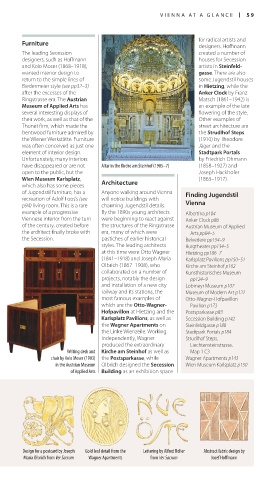
Design for a postcard by Joseph Gold leaf detail from the Lettering by Alfred Roller Abstract fabric design by
Maria Olbrich from Ver Sacrum Wagner Apartments from Ver Sacrum Josef Hoffmann
058-059_EW_Vienna.indd 59 03/10/17 11:00 am

