


Page 62 - American Rifleman (February 2020)
P. 62
U. S. T3 CARBINE


                      or countless centuries,   ghting men have used
                      the cloak of darkness for concealment from their
                      adversaries. Various methods were devised to

                      counter this advantage, including torches,  ares,
              rockets and, later, searchlights, but these proved to be
              ineffective for a variety of reasons. World War I resulted in
              renewed interest in the development of night-vision tech-
              nology, but no notable advances were forthcoming by the
              time of the Armistice.
                 Early in World War II, the Germans developed some
              rather rudimentary night-vision devices, but, due to the
              size and weight of the equipment, their use was initially
              restricted primarily to tanks and other vehicles. The Soviet
              Union also experimented with night vision circa 1942, but
              little progress was made by the time the war ended.
                 When the United States entered World War II and our
              troops were deployed to the Paci  c Theater, it became pain-  scope added rather signi  cant weight and bulk, and a car-
              fully apparent that the Japanese were masters in nighttime   bine   tted with the relatively cumbersome infrared sight
              in ltration tactics. It was equally apparent that effective   would be easier to handle than a heavier ri  e, such as the

              night-vision devices would be extremely helpful in combating   M1 Garand.
              this very real threat.                               In June 1943, the Army Ground Forces Headquarters had
                 To that end, in 1943, the U.S. Army Engineer Board at   developed a carbine   tted with a telescopic sight to deter-
              Fort Belvoir, Va., began development of an infrared sight   mine the feasibility of a lightweight sniper ri  e. The Inland
              to provide night-vision capability to our troops. The Army   Mfg. Division of General Motors fabricated a carbine with
              engineers devised a rather rudimentary instrument con-  integral scope mount brazed onto the receiver and   tted
              sisting of an electronic telescope and sealed-beam light,   with a Weaver M73B1 telescope as used with the Remington
              somewhat similar to an automobile headlight,   tted with   M1903A4 sniper ri  e. The prototype “sniper carbine” was
              an infrared   lter. A lead-acid battery to power the device   designated the M1E7. Extensive testing was conducted at
              was carried in a canvas knapsack. An improved version of   Aberdeen Proving Ground from early November 1943 to
              the infrared sight was designated as the T120.    January 1944. The results were not impressive, and the
                 The Army eventually decided that an M1 carbine with   M1E7 telescopic-sighted carbine was not recommended
              a suitable mount to accommodate the sight would be a   for further service testing or adoption. However, it was
              satisfactory platform for such use. Since night shooting   recognized that the basic design of the modi  ed “sniper
              would typically be at relatively close range, the .30 Carbine   carbine” would be ideal for use with the infrared sight.
              cartridge was believed to be adequate. Also, the infrared   Inland was selected to develop a carbine based on the
                                                                experimental M1E7, with an integral receiver mount to
                                                                accommodate the infrared sight. The modi  ed carbine


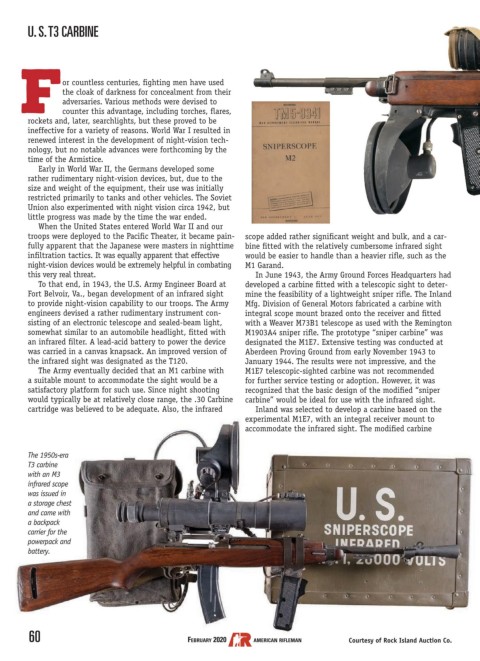
              The 1950s-era
              T3 carbine
              with an M3
              infrared scope
              was issued in
              a storage chest
              and came with
              a backpack
              carrier for the
              powerpack and
              battery.


               60                                  FEBRUARY 2020  AMERICAN RIFLEMAN     Courtesy of Rock Island Auction Co.

