


Page 63 - American Rifleman (February 2020)
P. 63
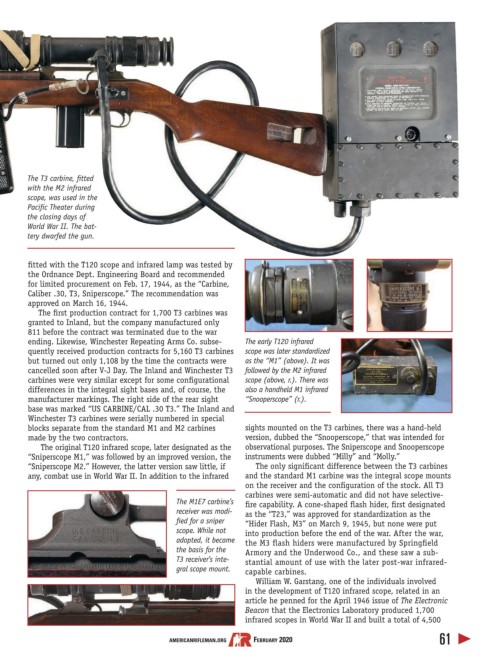
The T3 carbine,   tted
              with the M2 infrared
              scope, was used in the
              Paci  c Theater during
              the closing days of
              World War II. The bat-
              tery dwarfed the gun.


                 tted with the T120 scope and infrared lamp was tested by
               the Ordnance Dept. Engineering Board and recommended
               for limited procurement on Feb. 17, 1944, as the “Carbine,
               Caliber .30, T3, Sniperscope.” The recommendation was
               approved on March 16, 1944.
                 The   rst production contract for 1,700 T3 carbines was
               granted to Inland, but the company manufactured only
               811 before the contract was terminated due to the war
               ending. Likewise, Winchester Repeating Arms Co. subse-  The early T120 infrared
               quently received production contracts for 5,160 T3 carbines   scope was later standardized
               but turned out only 1,108 by the time the contracts were   as the “M1” (above). It was
               cancelled soon after V-J Day. The Inland and Winchester T3   followed by the M2 infrared
               carbines were very similar except for some con  gurational   scope (above, r.). There was
               differences in the integral sight bases and, of course, the   also a handheld M1 infrared
               manufacturer markings. The right side of the rear sight   “Snooperscope” (r.).
               base was marked “US CARBINE/CAL .30 T3.” The Inland and
               Winchester T3 carbines were serially numbered in special
               blocks separate from the standard M1 and M2 carbines   sights mounted on the T3 carbines, there was a hand-held
               made by the two contractors.                     version, dubbed the “Snooperscope,” that was intended for
                  The original T120 infrared scope, later designated as the   observational purposes. The Sniperscope and Snooperscope
               “Sniperscope M1,” was followed by an improved version, the   instruments were dubbed “Milly” and “Molly.”
               “Sniperscope M2.” However, the latter version saw little, if   The only signi  cant difference between the T3 carbines
               any, combat use in World War II. In addition to the infrared   and the standard M1 carbine was the integral scope mounts
                                                                on the receiver and the con  guration of the stock. All T3
                                                                carbines were semi-automatic and did not have selective-
                                                 The M1E7 carbine’s     re capability. A cone-shaped  ash hider,   rst designated

                                                 receiver was modi-  as the “T23,” was approved for standardization as the
                                                   ed for a sniper   “Hider Flash, M3” on March 9, 1945, but none were put
                                                 scope. While not   into production before the end of the war. After the war,
                                                 adopted, it became   the M3   ash hiders were manufactured by Spring  eld
                                                 the basis for the   Armory and the Underwood Co., and these saw a sub-
                                                 T3 receiver’s inte-  stantial amount of use with the later post-war infrared-
                                                 gral scope mount.  capable carbines.
                                                                   William W. Garstang, one of the individuals involved
                                                                in the development of T120 infrared scope, related in an
                                                                article he penned for the April 1946 issue of The Electronic
                                                                Beacon that the Electronics Laboratory produced 1,700
                                                                infrared scopes in World War II and built a total of 4,500

                                                                                                             61
                                               AMERICANRIFLEMAN.ORG  FEBRUARY 2020

