


Page 143 - (DK Eyewitness) Travel Guide - Estonia Latvia & Lithuania
P. 143
THE HIST OR Y OF LA T VIA 141
Gorbachev, but it collapsed within two
days and Latvia suddenly found itself free.
Latvia was led during the first eight years
of independence by Guntis Ulmanis
(b.1939). Governments came and went
as they had done in the 1920s, but they
largely agreed on a slower policy of
privatization than the Estonians were
practising. The poor salaries being paid in
the public sector continued the low-level
corrup tion prevalent in the Soviet era and
introduced it at higher levels too.
The beginning of the 21st century saw
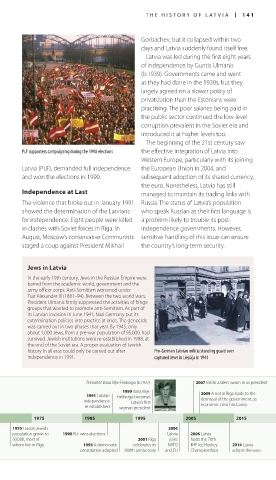
PLF supporters campaigning during the 1990 elections the effective integration of Latvia into
Western Europe, particularly with its joining
Latvia (PLF), demanded full independence the European Union in 2004, and
and won the elections in 1990. subsequent adoption of its shared currency,
the euro. Nonetheless, Latvia has still
Independence at Last managed to maintain its trading links with
The violence that broke out in January 1991 Russia. The status of Latvia’s population
showed the determina tion of the Latvians who speak Russian as their first language is
for independence. Eight people were killed a problem likely to trouble its post-
in clashes with Soviet forces in Rīga. In independence gov ernments. However,
August, Moscow’s conservative Communists sensitive hand ling of this issue can ensure
staged a coup against President Mikhail the country’s long-term security.
Jews in Latvia
In the early 19th century, Jews in the Russian Empire were
barred from the academic world, government and the
army officer corps. Anti-Semitism worsened under
Tsar Alexander III (1881–94). Between the two world wars,
President Ulmanis firmly suppressed the activities of fringe
groups that wanted to promote anti-Semitism. As part of
its Latvian invasion in June 1941, Nazi Germany put its
extermination policies into practice at once. The genocide
was carried out in two phases that year. By 1945, only
about 1,000 Jews, from a pre-war population of 95,000, had
survived. Jewish institutions were re-established in 1988, at
the end of the Soviet era. A proper evaluation of Jewish
history in all eras could only be carried out after Pro-German Latvian militia standing guard over
independence in 1991. captured Jews in Liepāja in 1941
President Vaira Vīķe-Freiberga (b.1937) 2007 Valdis Zatlers sworn in as president
1999 Vaira Vīķe-
1991 Latvian Freiberga becomes 2009 A riot in Rīga leads to the
independence Latvia’s first dismissal of the government, as
re-established woman president economic crisis hits Latvia
1965 1975 1985 1995 2005 2015
1970 Latvia’s Jewish 2004
population grows to 1990 PLF wins elections Latvia 2006 Latvia
50,000, most of 2001 Rīga joins hosts the 70th
whom live in Rīga 1993 A democratic celebrates its NATO IIHF Ice Hockey 2014 Latvia
constitution adopted 800th anniversary and EU Championships adopts the euro
BT_138-141_HistEst.indd 141 25/02/2015 13:37

