


Page 142 - (DK Eyewitness) Travel Guide - Estonia Latvia & Lithuania
P. 142
140 INTRODUCING LA T VIA
The First Independence Latvia a part of the USSR. Anyone who had
Latvia’s newly formed government was played a significant role in “bourgeois”
forced to flee to Liepāja in January 1919, Latvia was either executed or deported to
returning to Rīga in July, when the city had Siberia. The German invasion followed a
been freed of Bolshevik troops. year later, in June 1941, and most
Throughout that year, many forces of Latvia was occupied within
were ranged against Latvian inde 10 days. The Nazi regime was as
pendence and against each other, brutal, but with different targets.
including the Germans, Poles and Most of its victims were from the
Russians. Latvia was only assured of its Jewish com munity, which had
inde pendence when it signed a peace grown considerably after the
treaty with Russia on 11 August 1920. laws which restricted Jewish
Despite the constantly changing resi dence were lifted in 1840.
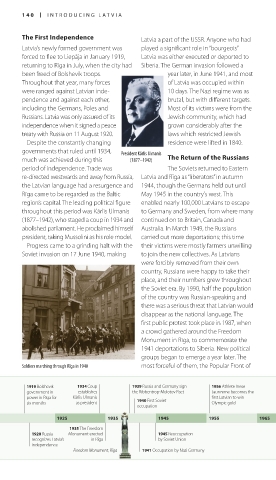
governments that ruled until 1934, President Kārlis Ulmanis
much was achieved during this (1877–1942) The Return of the Russians
period of indep endence. Trade was The Soviets returned to Eastern
redirected west wards and away from Russia, Latvia and Rīga as “liberators” in autumn
the Latvian language had a resurgence and 1944, though the Germans held out until
Rīga came to be regarded as the Baltic May 1945 in the country’s west. This
region’s capital. The leading political figure enabled nearly 100,000 Latvians to escape
through out this period was Kārlis Ulmanis to Germany and Sweden, from where many
(1877–1942), who staged a coup in 1934 and continued on to Britain, Canada and
abolished parliament. He proclaimed himself Australia. In March 1949, the Russians
president, taking Mussolini as his role model. carried out more deportations; this time
Progress came to a grinding halt with the their victims were mostly farmers unwilling
Soviet invasion on 17 June 1940, making to join the new collectives. As Latvians
were forcibly removed from their own
country, Russians were happy to take their
place, and their numbers grew throughout
the Soviet era. By 1990, half the population
of the country was Russianspeaking and
there was a serious threat that Latvian would
dis appear as the national language. The
first public protest took place in 1987, when
a crowd gathered around the Freedom
Monument in Rīga, to com memorate the
1941 deportations to Siberia. New political
groups began to emerge a year later. The
Soldiers marching through Rīga in 1940 most forceful of them, the Popular Front of
1919 Bolshevik 1934 Coup 1939 Russia and Germany sign 1956 Athlete Inese
government in establishes the RibbentropMolotov Pact Jaunzeme becomes the
power in Rīga for Kārlis Ulmanis first Latvian to win
six months as president 1940 First Soviet Olympic gold
occupation
1925 1935 1945 1955 1965
1935 The Freedom
1920 Russia Monument erected 1945 Reoccupation
recognizes Latvia’s in Rīga by Soviet Union
independence
Freedom Monument, Rīga 1941 Occupation by Nazi Germany
BT_138-141_HistEst.indd 140 25/02/2015 13:37

