


Page 140 - (DK Eyewitness) Travel Guide - Estonia Latvia & Lithuania
P. 140
138 INTRODUCING LA T VIA
THE HISTORY OF LATVIA
Latvia’s history is traditionally considered to have begun with the advent of the
Teutonic Knights in 1201, which started German dominance of the area for three
centuries. From the mid-16th to the early 18th century, Latvia was divided between
Poland and Sweden. By 1795, all of Latvia had been absorbed into Russia. Final
indepen dence from foreign domination was only achieved in 1991.
Latvia’s strategic geographical position, The Germans and the Swedes
which prompted its more powerful The power of the Germans quickly
neighbours to gain control over the extended across all of Latvia. Castles
region, largely decided the course of were built in Cēsis (1209), Kuldīga
its history. By the late 12th cen tury, (1242) and Valmiera (1283) to prevent
Latvia’s trade route up the Daugava any local resistance. Meanwhile,
river was increasingly visited by Rīga, Cēsis and Ventspils began to
merchants from Western Europe. thrive as members of the Hanseatic
The Teutonic Knights, German League (see p36). The beneficiaries of
warrior-monks who first arrived in Teutonic Knight in this growth were the Germans, who
1200, were looking for conquests as battle gear also owned large manors in the
well as new converts in a pagan countryside. The Latvians, on the
land. In 1201, they founded Rīga, other hand, were dis possessed and forced
which grew into an important centre for to become serfs.
trade between the Baltic region and The early 16th century saw the
Western Europe. population lending zealous support to
the Reformation movement, and soon
after, Protestantism was declared as the
state religion. In 1561, during the Livonian
Wars (see p37), Poland conquered Latvia
and Catholicism was firmly estab lished.
The separate Duchy of Courland, owing
allegiance to Poland, was created in the
south and west.
The clash between the Protestant
Swedes and Catholic Poles in the late
16th century resulted in Swedish rule in
northern Latvia for much of the 17th
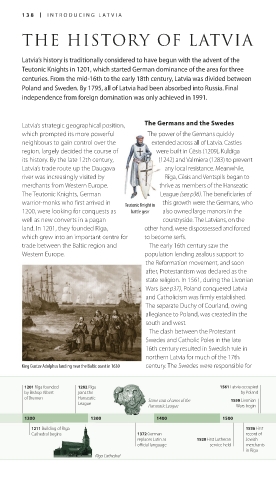
King Gustav Adolphus landing near the Baltic coast in 1630 century. The Swedes were responsible for
1201 Rīga founded 1282 Rīga 1561 Latvia occupied
by Bishop Albert joins the by Poland
of Bremen Hanseatic Stone coat of arms of the 1558 Livonian
League
Hanseatic League Wars begin
1200 1300 1400 1500
1211 Building of Rīga 1536 First
Cathedral begins 1372 German record of
replaces Latin as 1520 First Lutheran Jewish
official language service held merchants
in Rīga
Rīga Cathedral
BT_138-141_HistEst.indd 138 25/02/2015 13:37

