


Page 150 - (DK Eyewitness) Travel Guide - Estonia Latvia & Lithuania
P. 150
148 LA T VIA REGION B Y REGION
9 Parliament
Saeima
Jēkaba 11. Map 1 C3. ∑ saeima.lv
This rather anonymous
building, constructed from
1863 to 1867 with Florentine
Renaissance features, and
renovated several times since,
was originally used for meet-
ings of the local landed gentry.
From 1919 to 1934, as today,
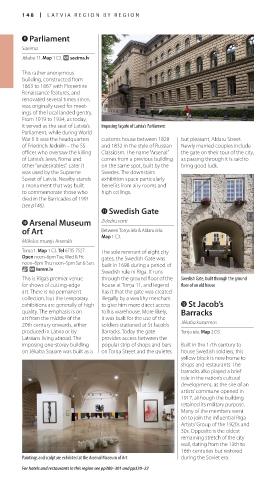
it served as the seat of Latvia’s Imposing façade of Latvia’s Parliament
Parliament, while during World
War II it was the headquarters customs house between 1828 but pleasant, Aldaru Street.
of Friedrich Jeckeln – the SS and 1832 in the style of Russian Newly married couples include
officer who oversaw the killing Classicism. The name “Arsenal” the gate on their tour of the city,
of Latvia’s Jews, Roma and comes from a pre vious building as passing through it is said to
other “undesi rables”. Later it on the same spot, built by the bring good luck.
was used by the Supreme Swedes. The downstairs
Soviet of Latvia. Nearby stands exhibition space particularly
a monument that was built benefits from airy rooms and
to commemorate those who high ceilings.
died in the Barricades of 1991
(see p146).
q Swedish Gate
0 Arsenal Museum Zviedru vārti
of Art Between Torņa iela & Aldaru iela.
Map 1 C3.
Mākslas muzejs Arsenāls
Torņa 1. Map 1 C3. Tel 6735 7527. The sole remnant of eight city
Open noon–6pm Tue, Wed & Fri; gates, the Swedish Gate was
noon–8pm Thu; noon–5pm Sat & Sun. built in 1698 during a period of
& ∑ lnmm.lv
Swedish rule in Rīga. It runs
This is Rīga’s premier venue through the ground floor of the Swedish Gate, built through the ground
for shows of cutting-edge house at Torņa 11, and legend floor of an old house
art. There is no permanent has it that the gate was created
collection, but the temporary illegally by a wealthy mer chant
exhibitions are generally of high to give him more direct access w St Jacob’s
quality. The emphasis is on to his warehouse. More likely, Barracks
art from the middle of the it was built for the use of the
20th century onwards, either soldiers stationed at St Jacob’s Jēkaba kazarmas
produced in Latvia or by Barracks. Today the gate Torņa iela. Map 2 D3.
Latvians living abroad. The provides access between the
imposing one-storey building popular strip of shops and bars Built in the 17th century to
on Jēkaba Square was built as a on Torņa Street and the quieter, house Swedish soldiers, this
yellow block is now home to
shops and restaurants. The
barracks also played a brief
role in the nation’s cultural
development, as the site of an
artists’ commune opened in
1917, although the building
retained its military purpose.
Many of the members went
on to join the influential Rīga
Artists’ Group of the 1920s and
30s. Opposite is the oldest
remaining stretch of the city
wall, dating from the 13th to
16th centuries but restored
Paintings and sculpture exhibited at the Arsenal Museum of Art during the Soviet era.
For hotels and restaurants in this region see pp300–301 and pp320–22
148-149_RigaCat2.indd 148 15/02/17 10:14 am

