


Page 151 - (DK Eyewitness) Travel Guide - Estonia Latvia & Lithuania
P. 151
RĪGA 149
e Powder Tower/ t Great Guild
Latvian War Lielā Ģilde
Museum Amatu 6. Map 2 D3. Tel 6722 4850.
Pulvertornis/Latvijas kara muzejs
Smilšu 20. Map 2 D3. Tel 6722 8147. Established in the 13th century,
Open May–Sep: 10am–6pm daily; the Great Guild had a monopoly
Oct–Apr: 10am–5pm daily. & on trade in Rīga for centuries.
donations. 8 ∑ karamuzejs.lv The building that served as the
guild’s headquarters was built
The cylindrical Powder Tower is from 1853 to 1860. An old guild
all that remains from a total of chamber displays symbols of
18 towers that were once part Hanseatic cities and the bridal
of the city’s defences. Its chamber was once used by
14th-century foundations are guild members’ children on
among the oldest in the city, Old issue of Lāčplēšis magazine at the their wedding nights. Today,
but the rest of the struc ture Latvian War Museum the building holds concerts by
dates from 1650, being rebuilt the Philharmonic Orchestra.
after it was destroyed by r Cats’ House
the Swedish army in 1621. Kaķu māja y Small Guild
The 2.5-m (8-ft) thick walls
were intended to protect the Meistaru iela 10. Map 2 D3. Mazā Ģilde
gunpowder stored inside, Amatu iela 5. Map 2 D3. Tel 6722
after which the tower was This yellow Art Nouveau building 3772. Open for concerts and confer-
named. Nine Russian cannon- on the corner of Meistaru and ences only. ∑ gilde.lv/maza
balls remain embedded in Amatu streets is a popular image
the walls as proof of the of Rīga for its two feline statues While the Great Guild counted
tower’s strength. on its rooftop. The story goes that the city’s merchants as its mem-
The tower was bought by a before World War I a merchant bers, the less powerful
German student fraternity at who owned the building was Small Guild existed to
the end of the 19th century refused entry to the Great Guild promote the interests of
and in 1919 it housed a because he was Latvian and Rīga’s German arti-
military museum reflecting membership was sans. This guild
on the then-recent fight for reserved for may have been
independence as well as on Germans only. In less prestigious
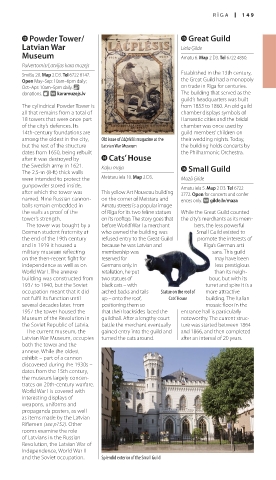
World War I. The annexe retaliation, he put than its neigh-
building was constructed from two statues of bour, but with its
1937 to 1940, but the Soviet black cats – with turret and spire it is a
occupation meant that it did arched backs and tails Statue on the roof of more attractive
not fulfil its function until up – onto the roof, Cats’ House building. The Italian
several decades later. From positioning them so mosaic floor in the
1957 the tower housed the that their backsides faced the entrance hall is particularly
Museum of the Revolution in guildhall. After a lengthy court noteworthy. The current struc-
the Soviet Republic of Latvia. battle the merchant eventually ture was started between 1864
The current museum, the gained entry into the guild and and 1866, and then completed
Latvian War Museum, occupies turned the cats around. after an interval of 20 years.
both the tower and the
annexe. While the oldest
exhibit – part of a cannon
discovered during the 1930s –
dates from the 15th century,
the museum largely concen-
trates on 20th-century war fare.
World War I is covered with
interesting displays of
weapons, uniforms and
propaganda posters, as well
as items made by the Latvian
Riflemen (see p152). Other
rooms examine the role
of Latvians in the Russian
Revolution, the Latvian War of
Independence, World War II
and the Soviet occupation. Splendid exterior of the Small Guild
148-149_RigaCat2.indd 149 15/02/17 10:14 am

