


Page 239 - (DK Eyewitness) Travel Guide - Estonia Latvia & Lithuania
P. 239
VILNIUS 237
Baroque Vilnius
The sensual waves, rich colours and theatrical stucco figures of Baroque architecture
reached Lithuania during the first half of the 17th century, replacing Gothic and
Renaissance. Italian masters, invited by Lithuania’s rulers, built Baroque gems such as
St Casimir’s Chapel (see p229) and the Church of St Theresa. In the mid-17th century came
a second resurgence of the style, when architects living in Vilnius began to develop a
distinct branch of Baroque. Led by Jan Krzysztof Glaubitz, they began to transform the
Old Town’s panorama by designing opu lent façades, matched by voluptuous interiors
and mul tiple altars. By the end of the 18th century Baroque had been replaced by the far
more res trained values of Neo-Classicism.
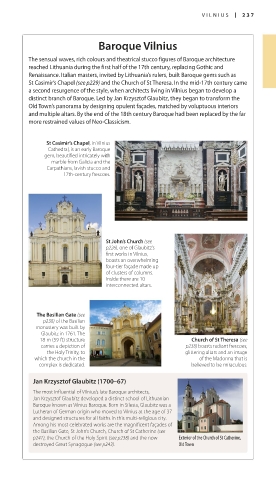
St Casimir’s Chapel, in Vilnius
Cathedral, is an early Baroque
gem, beautified intricately with
marble from Galicia and the
Carpathians, lavish stucco and
17th-century frescoes.
St John’s Church (see
p226), one of Glaubitz’s
first works in Vilnius,
boasts an overwhelming
four-tier façade made up
of clusters of columns.
Inside there are 10
inter connected altars.
The Basilian Gate (see
p238) of the Basilian
monastery was built by
Glaubitz in 1761. The
18-m (59-ft) structure Church of St Theresa (see
carries a depiction of p238) boasts radiant frescoes,
the Holy Trinity, to glitter ing altars and an image
which the church in the of the Madonna that is
complex is dedicated. believed to be miraculous.
Jan Krzysztof Glaubitz (1700–67)
The most influential of Vilnius’s late Baroque architects,
Jan Krzysztof Glaubitz developed a distinct school of Lithuanian
Baroque known as Vilnius Baroque. Born in Silesia, Glaubitz was a
Lutheran of German origin who moved to Vilnius at the age of 37
and designed structures for all faiths in this multi-religious city.
Among his most celebrated works are the magnificent façades of
the Basilian Gate, St John’s Church, Church of St Catherine (see
p241), the Church of the Holy Spirit (see p238) and the now Exterior of the Church of St Catherine,
destroyed Great Synagogue (see p243). Old Town
236-237.indd 237 15/02/17 10:16 am

