


Page 52 - (DK Eyewitness) Travel Guide - Estonia Latvia & Lithuania
P. 52
50       INTRODUCING  EST ONIA

                                            life, although hundreds of
                                            years of foreign occupation
                                            led to many people converting
                                            to Christianity, including
                                            Lutheranism and Russian
                                            Orthodoxy. The most imp ortant
                                            aspects of Estonian culture are
                                            distinctly pagan in origin. The
                                            hugely popular midsummer
                                            festival Jaanipäev (St John’s
                                            Day), characterized by drinking,
                                            dancing and revelry in the
                                            evening on 23 June and through
                                            to 24 June, has a pagan origin.

                                            Political Life
                                            Estonia underwent a major
                                            political transition in the 1990s,
                                            adopting a parliamentary
                                            democracy which introduced
                                            neo-liberal economic and
                                            political policies.
                                             In the early years of
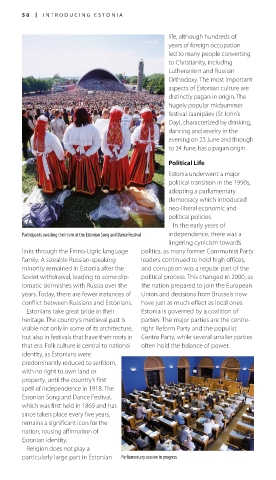
       Participants awaiting their turn at the Estonian Song and Dance Festival  independence, there was a
                                            lingering cynicism towards
       links through the Finno-Ugric language   politics, as many former Communist Party
       family. A sizeable Russian-speaking   leaders continued to hold high offices,
       minority remained in Estonia after the   and corruption was a regular part of the
       Soviet withdrawal, leading to some dip-  political process. This changed in 2000, as
       lomatic skirmishes with Russia over the   the nation prepared to join the European
       years. Today, there are fewer instances of   Union and decisions from Brussels now
       conflict between Russians and Estonians.  have just as much effect as local ones.
        Estonians take great pride in their   Estonia is governed by a coalition of
       heritage. The country’s medieval past is   parties. The major parties are the centre-
       visible not only in some of its architecture,   right Reform Party and the populist
       but also in festivals that have their roots in   Centre Party, while several smaller parties
       that era. Folk culture is central to national   often hold the balance of power.
       identity, as Estonians were
       predominantly reduced to serfdom,
       with no right to own land or
       property, until the country’s first
       spell of independence in 1918. The
       Estonian Song and Dance Festival,
       which was first held in 1869 and has
       since taken place every five years,
       remains a significant icon for the
       nation, rousing affirmation of
       Estonian identity.
         Religion does not play a
       particularly large part in Estonian   Parliamentary session in progress

