


Page 56 - (DK Eyewitness) Travel Guide - Estonia Latvia & Lithuania
P. 56
54       INTRODUCING  EST ONIA

       THE HISTORY OF

       ESTONIA


       Historical references to Estonia date from the early 13th century, when the German
       crusading knights arrived, introducing a new social order in which the Germans
       dom inated for several centuries. A brief but benevolent period of Swedish rule in the
       17th century was followed by Russian and German oppression, which continued
       with a short-lived inter-war independence. Estonia became a republic only in 1991.


       The German crusading order, the    their land given away to the Knights
       Brotherhood of the Sword, started    and bishops. The feudal system, in
       a bitter struggle for control of      which the Germans owned
       Estonia that lasted from 1208,        manor estates and the locals
       when they established their hold      were obliged to work as serfs,
       over Otepää, until 1211. The Danes,   survived until the 19th century.
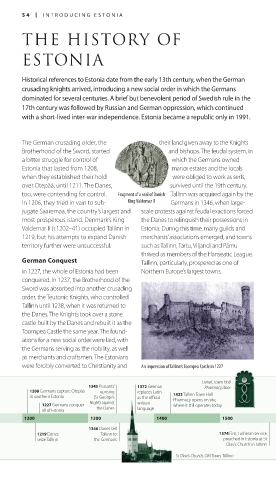
       too, were contending for control.   Fragment of a seal of Danish   Tallinn was acquired again by the
       In 1206, they tried in vain to sub-  King Valdemar II  Germans in 1346, when large-
       jugate Saaremaa, the country’s largest and   scale protests against feudal exactions forced
       most prosperous island. Denmark’s King   the Danes to relinquish their possessions in
       Valdemar II (r.1202–41) occupied Tallinn in   Estonia. During this time, many guilds and
       1219, but his attempts to expand Danish   merchants’ associations emerged, and towns
       territory further were unsuccessful.  such as Tallinn, Tartu, Viljandi and Pärnu
                                     thrived as members of the Hanseatic League.
       German Conquest               Tallinn, particularly, prospered as one of
       In 1227, the whole of Estonia had been   Northern Europe’s largest towns.
       conquered. In 1237, the Brotherhood of the
       Sword was absorbed into another crusading
       order, the Teutonic Knights, who controlled
       Tallinn until 1238, when it was returned to
       the Danes. The Knights took over a stone
       castle built by the Danes and rebuilt it as the
       Toompea Castle the same year. The found-
       ations for a new social order were laid, with
       the Germans serving as the nobility, as well
       as merchants and craftsmen. The Estonians
       were for cibly converted to Christianity and   An impression of Tallinn’s Toompea Castle in 1227

                                                     Detail, Town Hall
                        1343 Peasants’   1372 German   Pharmacy door
         1208 Germans capture Otepää   uprising    replaces Latin
         in southern Estonia  (St George’s   as the official   1422 Tallinn Town Hall
                                             Pharmacy opens on site,
            1227 Germans conquer   Night) against   written   where it still operates today
            all of Estonia  the Danes  language
       1200             1300             1400             1500
                        1346 Danes sell
           1219 Danes      Tallinn to                    1574 First Lutheran service
           seize Tallinn  the Germans                     preached in Estonia at St
                                                           Olav’s Church in Tallinn
                                              St Olav’s Church, Old Town, Tallinn

