


Page 57 - (DK Eyewitness) Travel Guide - Estonia Latvia & Lithuania
P. 57
THE  HIST OR Y  OF  EST ONIA       55


                                     as well as curbing use of the Estonian
                                     language. The resulting discontent among
                                     the intelligent sia found expression in the
                                     rebellion led by the students of Tartu
                                     University in the late 19th century.
                                       In 1905, as in many other places in Russia,
                                     Estonia witnessed widespread unrest. In the
                                     towns, factory
                                     workers lent support
                                     to the nascent
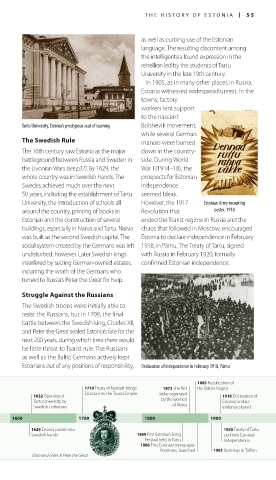
       Tartu University, Estonia’s prestigious seat of learning  Bolshevik movement,
                                     while several German
       The Swedish Rule              manors were burned
       The 16th century saw Estonia as the major   down in the coun try-
       battleground between Russia and Sweden in   side. During World
       the Livonian Wars (see p37). By 1629, the   War I (1914–18), the
       whole country was in Swedish hands. The   prospects for Estonian
       Swedes achieved much over the next    inde pendence
       50 years, including the establishment of Tartu   seemed bleak.
       University, the introduction of schools all   However, the 1917   Estonian Army recruiting
       around the country, print ing of books in   Revolution that   poster, 1918
       Estonian and the construction of several   ended the Tsarist regime in Russia and the
       buildings, especially in Narva and Tartu. Narva   chaos that followed in Moscow, encouraged
       was built as the second Swedish capital. The   Estonia to declare independence in February
       social system created by the Germans was left  1918, in Pärnu. The Treaty of Tartu, signed
       undisturbed, however. Later Swedish kings   with Russia in February 1920, formally
       inter fered by seizing German-owned estates,   confirmed Estonian independence.
       incurring the wrath of the Germans who
       turned to Russia’s Peter the Great for help.

       Struggle Against the Russians
       The Swedish troops were initially able to
       resist the Russians, but in 1709, the final
       battle between the Swedish king, Charles XII,
       and Peter the Great sealed Estonia’s fate for the
       next 200 years, during which time there would
       be little threat to Tsarist rule. The Russians
       as well as the Baltic Germans actively kept
       Estonians out of any positions of responsibility,   Declaration of independence in February 1918, Pärnu

                                                    1885 Russification of
                       1710 Treaty of Nystadt brings   1872 The first   the Baltics begins
                       Estonia into the Tsarist Empire  strike organized
          1632 Opening of                                 1918 Declaration of
          Tartu University by             by the women     Estonian indep-
          Swedish Lutherans                  of Narva     endence signed
    1600             1700             1800             1900
         1629 Estonia passes into                         1920 Treaty of Tartu
         Swedish hands              1869 First Estonian Song   confirms Estonia’s
                                      Festival held in Tartu  independence
                                     1886 First Estonian newspaper,
                                          Postimees, launched  1905 Uprisings in Tallinn
         Diamond order of Peter the Great

