


Page 58 - (DK Eyewitness) Travel Guide - Estonia Latvia & Lithuania
P. 58
56       INTRODUCING  EST ONIA


                                     by many in Estonia as a sort of liberation.
                                     Tallinn-born Alfred Rosenberg, who was
                                     appointed by Nazi Germany to run the Baltic
                                     States, treated the gene ral population less
                                     harshly than his counterparts in other
                                     countries subjected to Nazi occupation. In
                                     September 1944, the advancing Red Army
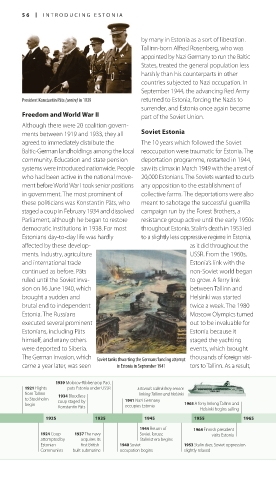
       President Konstantin Päts (centre) in 1939  returned to Estonia, forcing the Nazis to
                                     surrender, and Estonia once again became
       Freedom and World War II      part of the Soviet Union.
       Although there were 20 coalition govern-
       ments between 1919 and 1933, they all   Soviet Estonia
       agreed to immediately dis tribute the    The 10 years which followed the Soviet
       Baltic-German land holdings among the local   reoccupation were traumatic for Estonia. The
       community. Education and state pension   deportation programme, restarted in 1944,
       systems were introduced nationwide. People   saw its climax in March 1949 with the arrest of
       who had been active in the national move-  20,000 Estonians. The Soviets wanted to curb
       ment before World War I took senior positions   any opposition to the establishment of
       in government. The most prominent of   collective farms. The deportations were also
       these politicians was Konstantin Päts, who   meant to sabotage the successful guerrilla
       staged a coup in February 1934 and dissolved   campaign run by the Forest Brothers, a
       Parliament, although he began to restore   resistance group active until the early 1950s
       democratic institutions in 1938. For most   throughout Estonia. Stalin’s death in 1953 led
       Estonians day-to-day life was hardly   to a slightly less oppressive regime in Estonia,
       affected by these develop-                 as it did throughout the
       ments. Industry, agriculture               USSR. From the 1960s,
       and international trade                    Estonia’s link with the
       continued as before. Päts                  non-Soviet world began
       ruled until the Soviet inva-               to grow. A ferry link
       sion on 16 June 1940, which                between Tallinn and
       brought a sudden and                       Helsinki was started
       brutal end to independent                  twice a week. The 1980
       Estonia. The Russians                      Moscow Olympics turned
       executed several pro minent                out to be inva luable for
       Estonians, including Päts                  Estonia because it
       himself, and many others                   staged the yachting
       were deported to Siberia.                  events, which brought
       The German invasion, which                 thou sands of foreign visi-
                          Soviet tanks thwarting the Germans’ landing attempt
       came a year later, was seen   in Estonia in September 1941  tors to Tallinn. As a result,
               1939 Molotov-Ribbentrop Pact
       1921 Flights   puts Estonia under USSR  Estonia’s Tallink ferry service
       from Tallinn    1934 Bloodless   linking Tallinn and Helsinki
       to Stockholm   coup staged by   1941 Nazi Germany
       begin                                    1965 A ferry linking Tallinn and
                Konstantin Päts  occupies Estonia
                                                    Helsinki begins sailing
             1925        1935         1945         1955         1965
                                     1944 Return of    1964 Finnish president
           1924 Coup   1937 The navy   Soviet forces;    visits Estonia
           attempted by   acquires its    Stalinist era begins
           Estonian   first British-   1940 Soviet   1953 Stalin dies; Soviet oppression
           Communists  built submarine  occupation begins  slightly relaxed

