


Page 94 - (DK Eyewitness) Travel Guide - Estonia Latvia & Lithuania
P. 94
92       EST ONIA  REGION  B Y  REGION


       1 Paldiski
       Road Map C1. * 4,000. £
       @ 145 from Tallinn. ∑ paldiski.ee
       Deriving its name from the
       Estonian pronunciation of
       baltiyskiy, which means “Baltic”
       in Russian, Paldiski was
       established by Peter the Great in
       1718. Paldiski was known to be
       of strategic impor tance for the
       Russian Empire. In 1962, when
       the Soviet Navy nuclear sub-
       marine training centre was set
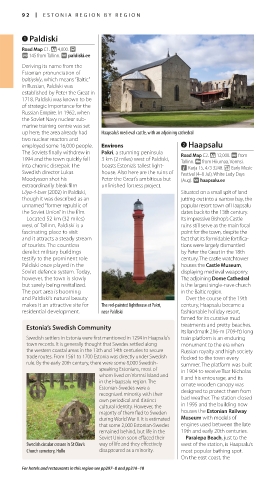
       up here, the area already had   Haapsalu’s medieval castle, with an adjoining cathedral
       two nuclear reactors and
       employed some 16,000 people.   Environs  2 Haapsalu
       The Soviets finally withdrew in   Pakri, a stunning peninsula    Road Map C2. * 12,000. @ from
       1994 and the town quickly fell   3 km (2 miles) west of Paldiski,   Tallinn. g from Hiiumaa, Vormsi.
       into chronic disrepair. The   boasts Estonia’s tallest light-  n Karja 15, 473 3248. _ Early Music
       Swedish director Lukas   house. Also here are the ruins of   Festival (4–8 Jul), White Lady Days
       Moodysson shot his   Peter the Great’s ambitious but   (Aug). ∑ haapsalu.ee
       extraordinarily bleak film    unfinished fortress project.
       Lilya-4-Ever (2002) in Paldiski,        Situated on a small spit of land
       though it was described as an           jutting out into a narrow bay, the
       unnamed “former republic of             popular resort town of Haapsalu
       the Soviet Union” in the film.          dates back to the 13th century.
         Located 52 km (32 miles)              Its impressive Bishop’s Castle
       west of Tallinn, Paldiski is a          ruins still serve as the main focal
       fascinating place to visit              point for the town, despite the
       and it attracts a steady stream         fact that its formidable fortifica-
       of tourists. The countless              tions were largely dismantled
       derelict military buildings             by Peter the Great in the 18th
       testify to the prominent role           century. The castle watchtower
       Paldiski once played in the             houses the Castle Museum,
       Soviet defence system. Today,           displaying medieval weaponry.
       how ever, the town is slowly            The adjoining Dome Cathedral
       but surely being revitalized.           is the largest single-nave church
       The port area is booming                in the Baltic region.
       and Paldiski’s natural beauty             Over the course of the 19th
       makes it an attractive site for   The red-painted lighthouse at Pakri,    century, Haapsalu became a
       residential development.  near Paldiski  fashionable holiday resort,
                                               famed for its curative mud
                                               treatments and pretty beaches.
        Estonia’s Swedish Community
                                               Its landmark 216-m (709-ft) long
        Swedish settlers in Estonia were first mentioned in 1294 in Haapsalu’s   train platform is an enduring
        town records. It is generally thought that Swedes settled along    monument to the era when
        the western coastal areas in the 13th and 14th centuries to secure   Russian royalty and high society
        trade routes. From 1561 to 1700 Estonia was directly under Swedish   flocked to the town every
        rule. By the early 20th century, there were some 8,000 Swedish-  summer. The platform was built
                           speaking Estonians, most of   in 1904 to receive Tsar Nicholas
                           whom lived on Vormsi Island and   II and his entourage, and its
                           in the Haapsalu region. The   ornate wooden canopy was
                           Estonian-Swedes were a
                           recognized minority with their   designed to protect them from
                           own periodical and distinct   bad weather. The station closed
                           cultural identity. How ever, the   in 1995 and the building now
                           majority of them fled to Sweden   houses the Estonian Railway
                           during World War II. It is estimated   Museum with models of
                           that some 2,000 Estonian-Swedes   engines used between the late
                           remained behind, but life in the   19th and early 20th centuries.
                           Soviet Union soon effaced their     Paralepa Beach, just to the
        Swedish circular crosses in St Olav’s   way of life and they effectively   west of the station, is Haapsalu’s
        Church cemetery, Hullo  disappeared as a minority.  most popular bath ing spot.
                                               On the east coast, the
       For hotels and restaurants in this region see pp297–8 and pp316–18

