


Page 115 - Vogue - India (January 2020)
P. 115
view


                                                      SUNITA NARAIN, 58
                                                      ENVIRONMENTAL ACTIVIST, DIRECTOR GENERAL OF CENTRE FOR SCIENCE AND
                                                      ENVIRONMENT (CSE) AND EDITOR OF DOWN TO EARTH, DELHI, INDIA
                                                      She’s a Padma Shri awardee, one of Time magazine’s 100 Most Influential People, has starred in
                                                      Leonardo DiCaprio’s documentary Before The Flood and is undoubtedly the pioneer of climate
                                                      justice as the foremost environmentalist in India. “We have a duty to hope,” says Sunita Narain,
                                                      who has been tirelessly fighting climate change for over three decades. She has moulded CSE
                                                      (where she’s worked since 1982) into the country’s leading environmental think tank, directly
                                                      influencing policy and public opinion. Under her directorship, it has been awarded the Stockholm
                                                      Water Prize (considered the Water Nobel) for its work on rainwater harvesting. Narain is a rare
                                                      leader who cuts through the politics and attacks the heart of the issue. “Urban India is falling
                                                      apart at the seams,” she says, citing an example of the air pollution that has spun out of control
                                                      and rattled north India. According to her, India stands at an inflection point: “The next five years
                                                      are crucial. The world will either become more climate-risked and insecure, or we will bend the
                                                      curve and move towards an inclusive and sustainable future.” This eternal optimist, though,
                                                      envisions the transformation of India through participatory democracy and knowledge-based
                                                      activism: “To be sustainable, growth must be affordable, inclusive and equitable.” – Neeti Mehra


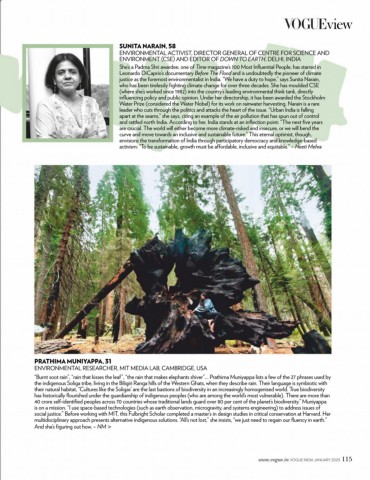
                PRATHIMA MUNIYAPPA, 31
                ENVIRONMENTAL RESEARCHER, MIT MEDIA LAB, CAMBRIDGE, USA

                “Burnt soot rain”, “rain that kisses the leaf”, “the rain that makes elephants shiver”… Prathima Muniyappa lists a few of the 27 phrases used by
                the indigenous Soliga tribe, living in the Biligiri Ranga hills of the Western Ghats, when they describe rain. Their language is symbiotic with
                their natural habitat, “Cultures like the Soligas’ are the last bastions of biodiversity in an increasingly homogenised world. True biodiversity
                has historically flourished under the guardianship of indigenous peoples (who are among the world’s most vulnerable). There are more than
                40 crore self-identified peoples across 70 countries whose traditional lands guard over 80 per cent of the planet’s biodiversity.” Muniyappa
                is on a mission. “I use space-based technologies (such as earth observation, microgravity, and systems engineering) to address issues of
                social justice.” Before working with MIT, this Fulbright Scholar completed a master’s in design studies in critical conservation at Harvard. Her
                multidisciplinary approach presents alternative indigenous solutions. “All’s not lost,” she insists, “we just need to regain our fluency in earth.”
                And she’s figuring out how. – NM >


                                                                                                                    www.vogue.in VOGUE INDIA JANUARY 2020  115

