


Page 117 - Vogue - India (January 2020)
P. 117
view


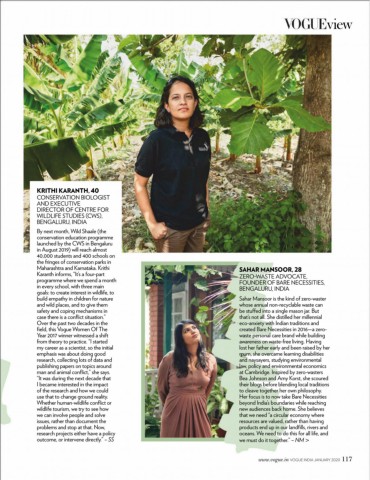
                 KRITHI KARANTH, 40
                 CONSERVATION BIOLOGIST
                 AND EXECUTIVE
                 DIRECTOR OF CENTRE FOR
                 WILDLIFE STUDIES (CWS),
                 BENGALURU, INDIA

                 By next month, Wild Shaale (the
                 conservation education programme
                 launched by the CWS in Bengaluru
                 in August 2019) will reach almost
                 40,000 students and 400 schools on
                 the fringes of conservation parks in
                 Maharashtra and Karnataka. Krithi                                                          SAHAR MANSOOR, 28
                 Karanth informs, “It’s a four-part                                                         ZERO-WASTE ADVOCATE,
                 programme where we spend a month                                                           FOUNDER OF BARE NECESSITIES,
                 in every school, with three main                                                           BENGALURU, INDIA
                 goals: to create interest in wildlife, to
                 build empathy in children for nature                                                       Sahar Mansoor is the kind of zero-waster
                 and wild places, and to give them                                                          whose annual non-recyclable waste can
                 safety and coping mechanisms in                                                            be stuffed into a single mason jar. But
                 case there is a conflict situation.”                                                       that’s not all. She distilled her millennial
                 Over the past two decades in the                                                           eco-anxiety with Indian traditions and
                 field, this Vogue Women Of The                                                             created Bare Necessities in 2016—a zero-
                 Year 2017 winner witnessed a shift                                                         waste personal care brand while building
                 from theory to practice. “I started                                                        awareness on waste-free living. Having
                 my career as a scientist, so the initial                                                   lost her father early and been raised by her
                 emphasis was about doing good                                                              mum, she overcame learning disabilities
                 research, collecting lots of data and                                                      and naysayers, studying environmental
                 publishing papers on topics around                                                         law, policy and environmental economics
                 man and animal conflict,” she says.                                                        at Cambridge. Inspired by zero-wasters
                 “It was during the next decade that                                                        Bea Johnson and Amy Korst, she scoured
                 I became interested in the impact                                                          their blogs before blending local traditions
                 of the research and how we could                                                           to cleave together her own philosophy.
                 use that to change ground reality.                                                         Her focus is to now take Bare Necessities
                 Whether human-wildlife conflict or                                                         beyond India’s boundaries while reaching
                 wildlife tourism, we try to see how                                                        new audiences back home. She believes
                 we can involve people and solve                                                            that we need “a circular economy where
                 issues, rather than document the                                                           resources are valued, rather than having
                 problems and stop at that. Now,                                                            products end up in our landfills, rivers and
                 research projects either have a policy                                                     oceans. We need to do this for all life, and
                 outcome, or intervene directly.” – SS                                                      we must do it together.” – NM >


                                                                                                                    www.vogue.in VOGUE INDIA JANUARY 2020 117

