


Page 119 - Vogue - India (January 2020)
P. 119
view


                                                               SONIA JABBAR
                                                               OWNER NUXALBARI TEA ESTATE, NAXALBARI, INDIA
                                                               In the Darjeeling district of West Bengal, people are wary of crop-raiding pachyderms
                                                               due to shrinking forest cover, but the Nuxalbari Tea Estate aims to be a safe space for
                                                               elephants. With its Hathi Sathi programme, Sonia Jabbar’s 1,200-acre tea estate has
                                                               received an Elephant Friendly Tea certification (a first in the country) from the Wildlife
                                                               Friendly Enterprise Network and the University of Montana. “We aim to raise the
                                                               consciousness of the residents here,” says Jabbar. This extends to about 2,500 people
                                                               who live on the estate (including 500 permanent workers and their families). There
                                                               are three principal aspects to this programme. “We actively protect the elephants. No
                                                               one is allowed to harass or tease them, even photographers aren’t allowed to get close.
                                                               Elephants like to be left alone, so we do that,” says Jabbar. There’s also a formalised
                                                               education programme for the children of the estate workers aiming to increase
                                                               awareness about environmental issues alongside a re-wilding programme that spans
                                                               over 100 acres. “Somehow, tea estates are monoculture, but I propagate a number of
                                                               native species to improve the biodiversity of our estate and provide a variety of plant
                                                               species for the elephants to feed on.” – SS


                 SHAGUN SINGH, 38
                 FOUNDER GEELI MITTI FARMS,
                 MAHRORA, INDIA

                 In Mahrora village, on the outskirts of
                 Nainital in Uttarakhand, little dwellings
                 that look like they’re right out of hobbit
                 land speckle the landscape. Geeli Mitti
                 Farms has become one of the leading
                 authorities on natural buildings in the
                 country, drawing architecture students
                 and enthusiasts from all over. But
                 that’s just one aspect of what it does.
                 Shagun Singh founded this collective
                 of 11 villages (that falls under the Naina
                 Devi Himalayan Bird Conservation
                 Reserve) after 10 years of MNC life. At
                 its demonstration permaculture farm,
                 Singh teaches you how to adapt these
                 practices to your home, whether it’s
                 a matchbox flat or a farmhouse. She
                 elaborates, “There are multiple versions
                 of every system that we demonstrate.
                 For example, there are three systems
                 of rainwater harvesting, four of sewage
                 management, three of composting, five
                 of grey-water recycling. People speak of
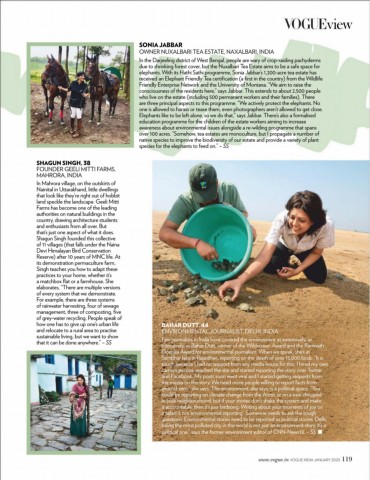
                 how one has to give up one’s urban life                 BAHAR DUTT, 44
                 and relocate to a rural area to practise                ENVIRONMENTAL JOURNALIST, DELHI, INDIA
                 sustainable living, but we want to show                 Few journalists in India have covered the environment as extensively, or
                 that it can be done anywhere.” – SS                     intensively, as Bahar Dutt, winner of the Wildscreen Award and the Ramnath
                                                                         Goenka Award for environmental journalism. When we speak, she’s at
                                                                         Sambhar lake in Rajasthan, reporting on the death of over 15,000 birds. “It is
                                                                         tough because I had no support from any media house for this. I hired my own
                                                                         camera person, reached the site and started reporting the story over Twitter
                                                                         and Facebook. My posts soon went viral and I started getting requests from
                                                                         the media on the story. We need more people willing to report facts from
                                                                         ground zero,” she says. The environment, she says, is a political space. “You
                                                                         could be reporting on climate change from the Arctic or on a tree chopped
                                                                         in your neighbourhood, but if your stories don’t shake the system and make
                                                                         it accountable, then it’s just birdsong. Writing about your moments of joy on
                                                                         a safari is not ‘environmental reporting’. Someone needs to ask the tough
                                                                         questions. Environmental stories need to be reported as political stories. Delhi
                                                                         being the most polluted city in the world is not just an environment story, it’s a
                                                                         political one,” says the former environment editor of CNN-News18. – SS n


                                                                                                                    www.vogue.in VOGUE INDIA JANUARY 2020 119

