


Page 121 - Vogue - India (January 2020)
P. 121
bility to make earth-conscious art. The
                                                              country produces over 60 million
                                                              tonnes of waste every year, much of it
                                                              in the form of non-biodegradable plas-
                                                              tic. Given the ubiquity of plastic bot-
                                                              tles and bags, these  objects have
                 SCOPE OF ART                                 inevitably acted as the building blocks
                 “Art can show new directions,”  says         of signifi cant artistic projects.
                 Agarwal, who works with a variety of            Between 2005 and 2008, Vivan
                 media, though his abiding focus is on        Sundaram made an entire body of
                 photography.  His current project is         work using,  and appropriately titling       reer in Marseille, France, was drawn to
                 called  The  Desert  Of  The  Anthropo-      it, Trash. From empty bottles to bro-        bricolage, a process of putting together
                 cene. “I am exploring the manner in          ken  pipes, he  put  every conceivable       works using what Indians call ‘jugaad’.
                 which the desert, my ancestral home-         residue of  urban  life  to creative  use.      “When you work with whatever ma-
                 land,  is being abandoned by  humans         Sundaram’s younger contemporary              terial  is  available  around  you,  you’re
                 but re-inhabited by  new signposts  of       Aaditi Joshi gravitates towards upcy-        taking part in an invitation to continue
                 global capital,” he says, explaining fur-    cling plastic bags into installations, as    a story, instead of starting with a blank
                 ther: “Industries such as mining, nu-        does Manish Nai, who works with              page,”  he  says. “I’m conscious about
                 clear testing sites, and urbanisation        recyclable material—old clothes, news-       not  wasting  my  resources.  I  like  the
                 are replacing more traditional aspects,      papers and cardboard boxes—that are          simplicity of my practice.” Segard, who
                 like  food production, leading to the        discarded every day.                         currently lives in Goa, has made ingen-
                 loss of human networks and ecological                                                     ious collages, where the jilted squalor
                 systems  that  were  for  long  interde-     LOOKING SIDEWAYS                             of life is harnessed into abstract shapes
                 pendent in the desert.” With major cit-      For artists who use found objects—           and structures. It’s as though he picks
                 ies choking with air pollution and           either because they cannot afford            up pieces of a broken dream and puts
                                     coastlines sinking,      expensive material or out of other com-      them together into all-new shapes.
                                     Indian artists have      pulsions—India offers a rich playing            A  different  kind  of  dreamscape  is
                                     an urgent responsi-      fi eld. Julien Segard, who began his ca-      palpable in Himali Singh Soin’s ongo-
                                                                                                           ing (since 2017) project, We Are Oppo-
                                                                                                           site Like That, based on her research in
                                                                                                           the Arctic and Antarctic circles. Win-
                                                                                                           ner of the London edition of the Frieze
                                                                                                           Artist Award 2019, Soin creates hyp-
                                                                                                           notic multidisciplinary works in which
                                                                                                           poetry, performance, dance and music
                                                                                                           come  together  seamlessly.  Soin  says
                                                                                                           she “seeks to create fi ctional myths for
                                                                                                           the two poles from the non-human
                                                                                                           perspective of a melting fossil that has
                                                                                                           witnessed  the  great  shifts  of  epochs:
                                                                                                           the ice”. The principal presence in her
                                                                                                           otherwise barren settings is “an alien
                                                                                                           fi gure, part cyborg, part vessel of some
                                                                                                           ancient feminine knowledge”. The
                                                                                                           scenario is meant to evoke dread and
                                                                                                           premonition, rather than convey
                                                                                                           obvious dire warnings.
                                                                                                              “I  don’t  think  climate  change  and
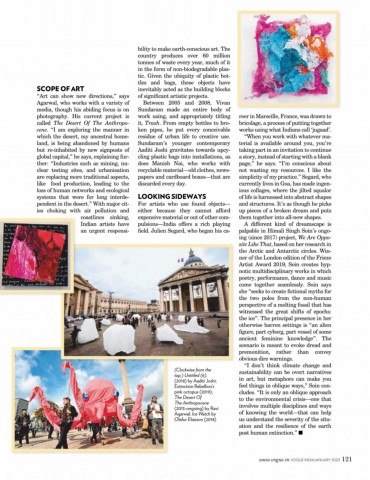
                                                                               (Clockwise from the         sustainability can be overt narratives
                                                                               top:) Untitled (6),
                                                                               (2018) by Aaditi Joshi;     in  art,  but  metaphors  can  make  you
                                                                               Extinction Rebellion’s      feel things in oblique ways,” Soin con-
                                                                               pink octopus (2019);        cludes. “It is only an oblique approach
                                                                               The Desert Of               to the environmental crisis—one that
                                                                               The Anthropocene
                                                                               (2013-ongoing) by Ravi      involves multiple disciplines and ways
                                                                               Agarwal; Ice Watch by       of knowing the world—that can help
                                                                               Olafur Eliasson (2018)      us understand the severity of the situ-
                                                                                                           ation and the resilience of the earth
                                                                                                           post human extinction.” ■


                                                                                                                    www.vogue.in VOGUE INDIAJANUARY       121

