


Page 156 - Vogue - India (January 2020)
P. 156
in


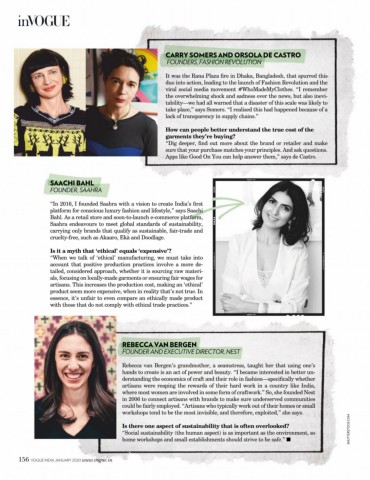
                                                                           CARRY SOMERS AND ORSOLA DE CASTRO
                                                                            FOUNDERS, FASHION REVOLUTION


                                                                           It was the Rana Plaza fi re in Dhaka, Bangladesh, that spurred this
                                                                           duo into action, leading to the launch of Fashion Revolution and the
                                                                           viral social media movement #WhoMadeMyClothes. “I remember
                                                                           the overwhelming shock and sadness over the news, but also inevi-
                                                                           tability—we had all warned that a disaster of this scale was likely to
                                                                           take place,” says Somers. “I realised this had happened because of a
                                                                           lack of transparency in supply chains.”


                                                                           How can people better understand the true cost of the
                                                                           garments they’re buying?
                                                                           “Dig deeper, fi nd out more about the brand or retailer and make
                                                                           sure that your purchase matches your principles. And ask questions.
                                                                           Apps like Good On You can help answer them,” says de Castro.


                       SAACHI BAHL
                       FOUNDER, SAAHRA


                       “In 2016, I founded Saahra with a vision to create India’s fi rst
                       platform for conscious luxury fashion and lifestyle,” says Saachi
                       Bahl. As a retail store and soon-to-launch e-commerce platform,
                       Saahra endeavours to meet global standards of sustainability,
                       carrying only brands that qualify as sustainable, fair-trade and
                       cruelty-free, such as Akaaro, Ekà and Doodlage.


                       Is it a myth that ‘ethical’ equals ‘expensive’?
                       “When we talk of ‘ethical’ manufacturing, we must take into
                       account that positive production practices involve a more de-
                       tailed, considered approach, whether it is sourcing raw materi-
                       als, focusing on locally-made garments or ensuring fair wages for
                       artisans. This increases the production cost, making an ‘ethical’
                       product seem more expensive, when in reality that’s not true. In
                       essence, it’s unfair to even compare an ethically made product
                       with those that do not comply with ethical trade practices.”


                                                       REBECCA VAN BERGEN
                                                       FOUNDER AND EXECUTIVE DIRECTOR, NEST


                                                       Rebecca van Bergen’s grandmother, a seamstress, taught her that using one’s
                                                       hands to create is an act of power and beauty. “I became interested in better un-
                                                       derstanding the economics of craft and their role in fashion—specifi cally whether
                                                       artisans were reaping the rewards of their hard work in a country like India,
                                                       where most women are involved in some form of craftwork.” So, she founded Nest
                                                       in 2006 to connect artisans with brands to make sure underserved communities
                                                       could be fairly employed. “Artisans who typically work out of their homes or small
                                                       workshops tend to be the most invisible, and therefore, exploited,” she says.


                                                       Is there one aspect of sustainability that is often overlooked?
                                                       “Social sustainability (the human aspect) is as important as the environment, so                      SHUTTERSTOCK.COM

                                                       home workshops and small establishments should strive to be safe.” ■


         156 VOGUE INDIA JANUARY      www.vogue.in

