


Page 152 - Vogue - India (January 2020)
P. 152
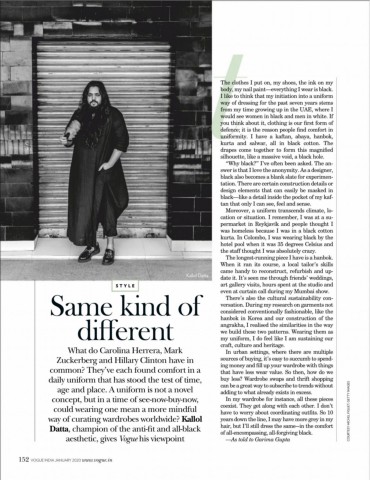
The clothes I put on, my shoes, the ink on my
                                                                                                   body, my nail paint—everything I wear is black.
                                                                                                   I like to think that my initiation into a uniform
                                                                                                   way of dressing for the past seven years stems
                                                                                                   from my time growing up in the UAE, where I
                                                                                                   would see women in black and men in white. If
                                                                                                   you think about it, clothing is our first form of
                                                                                                   defence; it is the reason people find comfort in
                                                                                                   uniformity. I have a kaftan, abaya, hanbok,
                                                                                                   kurta and salwar, all in black cotton. The
                                                                                                   drapes come together to form this magnified
                                                                                                   silhouette, like a massive void, a black hole.
                                                                                                      “Why black?” I’ve often been asked. The an-
                                                                                                   swer is that I love the anonymity. As a designer,
                                                                                                   black also becomes a blank slate for experimen-
                                                                                                   tation. There are certain construction details or
                                                                                                   design elements that can easily be masked in
                                                                                                   black—like a detail inside the pocket of my kaf-
                                                                                                   tan that only I can see, feel and sense.
                                                                                                      Moreover, a uniform transcends climate, lo-
                                                                                                   cation or situation. I remember, I was at a su-
                                                                                                   permarket in Reykjavík and people thought I
                                                                                                   was homeless because I was in a black cotton
                                                                                                   kurta. In Colombo, I was wearing black by the
                                                                                                   hotel pool when it was 35 degrees Celsius and
                                                                                                   the staff thought I was absolutely crazy.
                                                                                                      The longest-running piece I have is a hanbok.
                                                                                                   When it ran its course, a local tailor’s skills
                                                                                                   came handy to reconstruct, refurbish and up-
                                                                                    Kallol Datta   date it. It’s seen me through friends’ weddings,

                                                    STYLE                                          art gallery visits, hours spent at the studio and
                                                                                                   even at curtain call during my Mumbai show.
                       Same kind of                                                                versation. During my research on garments not
                                                                                                      There’s also the cultural sustainability con-


                                                                                                   considered conventionally fashionable, like the
                                   different                                                       hanbok in Korea and our construction of the
                                                                                                   angrakha, I realised the similarities in the way
                                                                                                   we build these two patterns. Wearing them as
                                                                                                   my uniform, I do feel like I am sustaining our
                                                                                                   craft, culture and heritage.
                               What do Carolina Herrera, Mark                                         In urban settings, where there are multiple

                          Zuckerberg and Hillary Clinton have in                                   sources of buying, it’s easy to succumb to spend-

                       common? They’ve each found comfort in a                                     ing money and fill up your wardrobe with things
                                                                                                   that have less wear value. So then, how do we
                      daily uniform that has stood the test of time,                               buy less? Wardrobe swaps and thrift shopping

                          age and place. A uniform is not a novel                                  can be a great way to subscribe to trends without
                                                                                                   adding to what already exists in excess.
                        concept, but in a time of see-now-buy-now,                                    In my wardrobe for instance, all these pieces
                         could wearing one mean a more mindful                                     coexist. They get along with each other. I don’t          COURTESY MICHEL FIGUET; GETTY IMAGES
                                                                                                   have to worry about coordinating outfits. So 10
                      way of curating wardrobes worldwide? Kallol                                  years down the line, I may have more grey in my

                       Datta, champion of the anti-fit and all-black                               hair, but I’ll still dress the same—in the comfort
                                                                                                   of all-encompassing, all-forgiving black.
                              aesthetic, gives Vogue his viewpoint                                    —As told to Garima Gupta


         152 VOGUE INDIA JANUARY 2020www.vogue.in

