


Page 151 - Vogue - India (January 2020)
P. 151
THE BRAND


                          Can the future be carbon-

                             neutral? We’re taking
                           notes from Gucci’s book

                          of sustainability on curbing
                          a brand’s carbon footprint


                        The Florentine label  publishes an
                   Environmental  Profi t  and  Loss  account
                   every  year  to  measure  its  impact  on the
                   environment. It was one of the fi rst fashion
                   brands to do so in 2017.
                       It has increased use of renewable energy
                   across all its operations, stores, offi ces and
                   warehouses. Currently, this accounts for                         THE INDIVIDUAL                                              Cyrill
                   per cent, but by 2020, it is targeting 100 p                                                                                 Gutsch
                   cent coverage.
                        Gucci  has  been  recycling  plastic  a             As the founder of Parley for the Oceans, Cyrill Gutsch
                   banned PVC since 2015.                                 has been tackling the problem of marine destruction with
                        It is shifting to low-impact raw mate
                   als  like  ECONYL,  regenerated  cashme                       innovation and collaboration. By Shalini Shah
                   and recycled or ethical gold.
                       It sources leather from farms that p             There’s a scene in Pirates Of The Caribbean: Curse Of The Black Pearl
                   serve ecosystems and avoid deforestation.            (2003), where a feisty Elizabeth Swann, cornered by Pintel and Ragetti,
                        Gucci reduces waste in manufacturi              invokes her right to ‘parley’—to be taken to the captain to have a conver-
                   processes with programmes like Scrap-Le              sation. That was 2003, and on a Disney movie set in an ocean-fi lled world
                   (to  use  fewer  chemicals  and  less  water         where not much time was spent on chit-chat. This is 2020, and we’re
                   treat  leather)  and  Gucci-Up  (to  upcy            feeling the pinch of not having had conversations that should have been
                   leather and textile waste).                          had. A world where 16-year-olds are, rightly, climate-shaming a genera-
                       It supports forest conservation throu            tion that failed to act when it needed to. But some are trying, on an indi-
                   four REDD+ projects in Peru, Kenya, In               vidual level, to right the wrongs done to our oceans and natural world.
                   nesia and Cambodia to offset all remaini               As the founder of Parley for the Oceans, Cyrill Gutsch has been part-
                   greenhouse gas emissions annually from its           nering with companies like Corona, Adidas and S’Well, to name a few, to
                   operations and the entire supply chain. The          raise awareness on damage to the oceans and institute projects to re-
                   project  also  economically  and  socially           verse and stop it. A signifi cant step has been the development of Parley
                   supports local communities.                          Ocean Plastic, an example of upcycling marine litter and turning it into
                                                                        covetable material for clothing and footwear.
                                                                          Gutsch, who started Parley for the Oceans in 2012, explains it as, “a
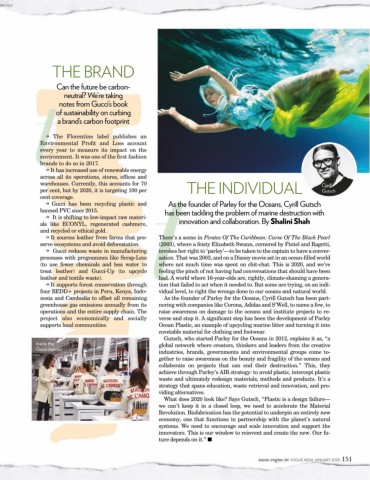
                 Inside the                                             global network where creators, thinkers and leaders from the creative
                 Gucci maison
                                                                        industries,  brands,  governments  and  environmental  groups  come  to-
                                                                        gether to raise awareness on the beauty and fragility of the oceans and
                                                                        collaborate  on  projects  that  can  end  their  destruction.”  This,  they
                                                                        achieve through Parley’s AIR strategy: to avoid plastic, intercept plastic
                                                                        waste and ultimately redesign materials, methods and products. It’s a
                                                                        strategy that spans education, waste retrieval and innovation, and pro-
                                                                        viding alternatives.
                                                                          What does 2020 look like? Says Gutsch, “Plastic is a design failure—
                                                                        we can’t keep it in a closed loop, we need to accelerate the Material
                                                                        Revolution. Biofabrication has the potential to underpin an entirely new
                                                                        economy, one that functions in partnership with the planet’s natural
                                                                        systems. We need to encourage and scale innovation and support the
                                                                        innovators. This is our window to reinvent and create the new. Our fu-

                                                                        ture depends on it.” ■


                                                                                                                    www.vogue.in VOGUE INDIA JANUARY       151

